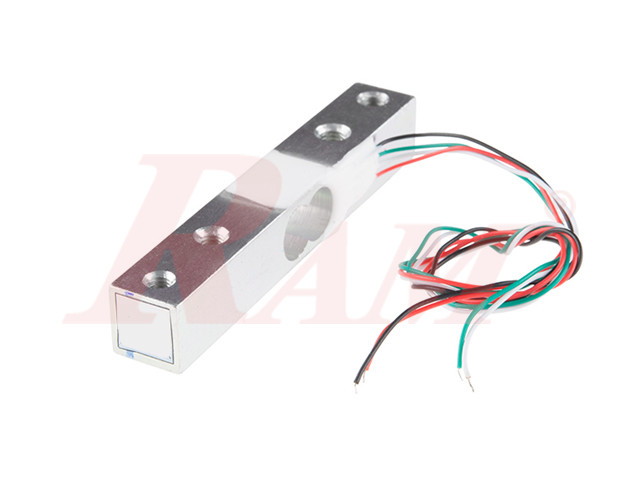
Load Cell 20Kg Weight Sensor - Strain Gauge
Internal Reference:
KIT.LOAD.CELL.20KG
General purpose load cell for weight sensing up to 20Kg (Size: 80 x 13 x 13 mm) - to buy additional Weight Scale Analog-to-Digital Converter (ADC) 24-bit board (HX711)
This straight bar load cell (sometimes called a strain gauge) can translate up to 20kg of pressure (force) into an electrical signal. Each load cell can measure the electrical resistance that changes in response to, and is proportional to, the strain (e.g. pressure or force) applied to the bar. With this gauge, you will be able to tell just how heavy an object is, if an object’s weight changes over time, or if you simply need to sense the presence of an object by measuring strain or load applied to a surface.
Each straight bar load cell is made from an aluminum alloy and is capable of reading a capacity of 20kg. These load cells have four strain gauges that are hooked up in a wheatstone bridge formation.
Wiring
The load cell acts like a bridge, it has 4 colored wires as follows
- VCC: Red wire
- GND: Black wire
- Signal +: Green wire
- Signal -: White wire
Technical Specifications
Here are some typical technical specifications for a 20kg load cell:
- Capacity: 20kg
- Material: Stainless steel or aluminum
- Output: mV/V
- Excitation voltage: 5-15V DC
- Non-linearity: <0.03% of full scale
- Hysteresis: <0.02% of full scale
- Creep: <0.03% of full scale per minute
- Operating temperature: -10°C to 40°C
- Protection class: IP65 or higher
How This Load Cell Works: Strain Gauge + Wheatstone Bridge
This straight bar load cell measures weight using four strain gauges bonded to an aluminum alloy bar, wired together in a Wheatstone bridge (the standard configuration for this type of sensor). As weight bends the bar by a tiny, invisible amount, the strain gauges' electrical resistance shifts, and the bridge converts that shift into a small differential voltage signal that changes in proportion to the load. On its own, this signal is too small for a microcontroller to read directly — it needs an ADC amplifier such as the HX711 Weight Scale ADC to boost and digitize it.
Choosing the Right Load Cell Capacity
A load cell 20kg rated like this one is sized for the heaviest object you expect to weigh — going over that rated capacity can damage the strain gauges permanently. If 20kg isn't the right fit for your project, RAM Electronics also stocks:
- 5kg load cell — for small parcels or kitchen-scale-sized projects.
- 40kg load cell and 50kg load cell — for mid-range weighing.
- 100kg load cell — for heavier loads.
As a rule of thumb in load-cell sizing, it's common to choose a rated capacity comfortably above your heaviest expected load rather than right at the limit, to leave headroom and protect the sensor from occasional overloads.
Building a Digital Scale With This Load Cell for Arduino
This load cell for Arduino projects needs just two other parts to become a working digital scale: an HX711 amplifier board and a microcontroller.
- Connect the load cell's 4 wires (Signal+, Signal-, VCC, GND, as listed above) to the HX711 board's matching terminals.
- Connect the HX711's data and clock lines to two digital pins on an Arduino UNO Rev3 (A65) or Arduino Nano (CH340), plus power and ground.
- Load an HX711 library, then calibrate by placing a known weight on the load cell and dividing the reading by that weight to get a calibration factor.
Frequently Asked Questions
What is a load cell?
A load cell is a sensor that converts a physical force, like weight, into an electrical signal. This one is a straight-bar type, sometimes also called a strain gauge.
How does a strain gauge load cell work?
Four strain gauges bonded to the bar are wired into a Wheatstone bridge. As the bar flexes slightly under load, the strain gauges' resistance changes, producing a small voltage signal proportional to the applied weight.
What does the wiring color code mean?
On this load cell: VCC is the red wire, GND is the black wire, Signal+ is the green wire, and Signal- is the white wire.
What capacity load cell do I need for my project?
Choose a rated capacity that comfortably covers the heaviest weight you plan to measure — going over the rated capacity can permanently damage the strain gauges.
Does this load cell need an amplifier to work with a microcontroller?
Yes. Its output signal is too small for a microcontroller to read directly, so it needs an ADC amplifier board such as the HX711 to boost and digitize the signal first.
Can this load cell be used with Arduino?
Yes — paired with an HX711 amplifier board, it connects to any Arduino board (or similar microcontroller) over two digital pins.
Building a digital scale for a school STEM project or a workshop tool this term? This load cell 20kg pairs directly with RAM's HX711 amplifier board for a complete weight-sensing setup. Contact RAM Electronics to check availability.