Building an electronics test bench feels overwhelming when you see professionals surrounded by expensive instruments. The good news: you need far fewer tools than you think, and you can add them one at a time.
This guide walks through the four core tools — the multimeter, the clamp meter, the oscilloscope, and the function generator — and shows exactly which one you need at each stage, so you never pay for capability you won't use yet.
Everything here is matched to real instruments available at RAM Electronics, the authorized distributor in Egypt for three trusted brands: UNI-T, FNIRSI, and Rigol. Start with one tool, and grow your bench as your projects demand.
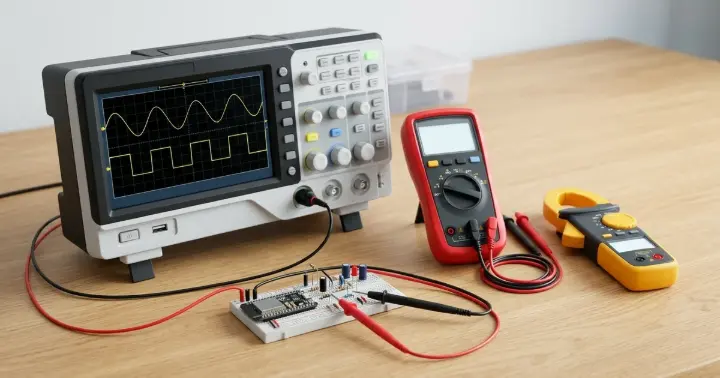
The Four Core Tools at a Glance
Before spending anything, it helps to see what each tool is actually for.
Tool | What it measures | Who needs it |
Multimeter | Voltage, current, resistance, continuity | Everyone — the first tool |
Clamp meter | Current, without breaking the circuit | Anyone working with higher currents or mains |
Oscilloscope | How a signal changes over time | Debugging timing, noise, and digital glitches |
Function generator | Produces test signals to feed a circuit | Testing filters, amplifiers, and sensors |
Most people need the first one or two. The rest come later, if at all.
Start Here: The Digital Multimeter
If you buy only one tool, buy a multimeter. It is the single most useful instrument on any bench.
A digital multimeter measures voltage, current, and resistance, and checks continuity — the everyday questions of "is there power here?", "is this wire broken?", and "what value is this resistor?". A True RMS meter also reads AC signals accurately, which cheaper meters get wrong.
For a full-featured workhorse, the UNI-T UT89X covers True RMS, high voltage and current ranges, capacitance, frequency, temperature, and non-contact voltage detection. If you want something simpler and more compact, the UNI-T UT122 is an easy everyday meter.
One safety note: check the meter's CAT rating against the voltages you work with. For mains and higher-energy circuits, a properly rated meter is not optional. UNI-T is a reliable, affordable brand, and RAM is its authorized distributor in Egypt.
Measuring Current Without Breaking the Circuit: The Clamp Meter
A normal multimeter measures current by putting the meter in the circuit — you have to cut the wire and wire the meter in. That is fine for a few milliamps on a breadboard, but impractical and unsafe for larger currents.
A clamp meter solves this. You simply clamp its jaws around a single wire, and it reads the current flowing through it without any contact. It is the right tool for motors, power supplies, and mains wiring.
The UNI-T UT204 measures up to 600 A on both AC and DC. If you want a clamp meter and a full multimeter in one instrument, the FNIRSI DMC100 combines both in a modern, compact body.
Seeing the Signal: When You Need an Oscilloscope
Here is the honest truth most buying guides skip: as a beginner, you probably do not need an oscilloscope yet. A multimeter answers most questions on a simple project.
You need a scope when you have to see how a signal behaves over time — the shape of a waveform, timing between signals, noise on a power rail, a PWM duty cycle, or an intermittent glitch a multimeter can never catch. That is the moment to step up.
When you do, four specs matter most:
- Channels. Two channels suit most work; four let you watch several signals or a digital bus at once.
- Bandwidth. A rough rule is to pick a bandwidth around five times the fastest signal you measure. 100 MHz covers the vast majority of microcontroller work.
- Sample rate. Higher is better, but remember it is usually shared across active channels.
- Resolution. A 12-bit scope shows finer detail than an older 8-bit model.
The Rigol DS1102Z-E is a proven 2-channel, 100 MHz scope with deep memory — a long-time favorite for hobbyists and labs. For a modern 4-channel option with 12-bit resolution and a touchscreen, the Rigol DHO814 captures more detail and more signals at once.
Rigol is a serious instrument brand, and buying a genuine unit matters for calibration and support. RAM is the authorized Rigol distributor in Egypt.
Generating Signals: The Function Generator
A function generator is the opposite of a scope: instead of reading a signal, it produces one. It feeds a clean, controlled waveform — sine, square, or a custom shape — into your circuit so you can test how the circuit responds.
It is an advanced tool, most useful for testing filters, amplifiers, and sensor front-ends, and it pairs naturally with an oscilloscope. The Rigol DG1022Z is a two-channel arbitrary waveform generator that covers this role on a hobbyist and educational bench.
One Tool to Start With: The 3-in-1 Handheld
If buying three or four separate instruments sounds like a lot, there is a shortcut worth knowing.
The FNIRSI DST210 packs a multimeter, a small oscilloscope, and a signal generator into one handheld device. It will not replace a full bench scope, but it is a brilliant way to get a taste of every measurement type in a pocket-sized tool — ideal for beginners, students, and fieldwork.
FNIRSI has become a favorite for exactly this kind of modern, affordable, portable gear, and RAM is its official distributor in Egypt.
Which Tools for Your Level?
You do not buy everything at once. You buy the next tool your projects actually ask for.
Your level | What you need | Good choices |
Beginner | A multimeter | UT89X, UT122, or the DST210 3-in-1 |
Hobbyist | Multimeter + clamp meter | Add the UT204 or FNIRSI DMC100 |
Advanced / Pro | Add a bench oscilloscope, then a generator | DS1102Z-E or DHO814, then the DG1022Z |
Buy in that order and every tool earns its place before the next one arrives.
Why Buy From an Authorized Distributor
Test equipment is exactly the kind of product where the seller matters as much as the model.
Grey-market instruments — sold cheaply through unofficial channels — often come with no manufacturer warranty, no support, and sometimes no guarantee the unit is genuine or correctly calibrated. For a measurement tool, a reading you cannot trust defeats the whole purpose.
RAM Electronics is the authorized distributor in Egypt for all three brands in this guide: UNI-T, Rigol, and FNIRSI. That means genuine units, a real manufacturer warranty, and local support — so the instrument you rely on to be accurate actually is.
Frequently Asked Questions
Do I need an oscilloscope as a beginner?
Usually not. A good multimeter answers most questions on simple projects. You need a scope only when you must see how a signal changes over time, such as timing, noise, or glitches. Many makers work happily for a long time with just a multimeter.
What is the difference between a multimeter and a clamp meter?
A multimeter measures current by being wired into the circuit, which means breaking it. A clamp meter reads current by clamping around a wire, with no contact — much safer and easier for larger currents like motors and mains.
Multimeter or oscilloscope — which should I buy first?
The multimeter, without question. It is cheaper, simpler, and covers the everyday checks every project needs. Add an oscilloscope later, when a problem needs you to see the signal itself.
What specs matter most in an oscilloscope?
Channels, bandwidth, sample rate, and resolution. Two channels and 100 MHz suit most microcontroller work; four channels help with digital buses; and a 12-bit model shows finer detail than an 8-bit one.
Is a 3-in-1 handheld tool good enough?
For learning and light work, yes. A device like the FNIRSI DST210 gives you a multimeter, a small scope, and a signal generator in one unit. It is a great starting point, though serious signal work still benefits from a full bench oscilloscope.
Why buy test equipment from an authorized distributor?
Because warranty, support, and authenticity depend on it. An authorized distributor supplies genuine, correctly specified units with a real manufacturer warranty — which matters most for instruments you trust to be accurate.
Build Your Bench, One Tool at a Time
A complete electronics test bench is not a single purchase — it is a sequence. Start with a reliable multimeter, add a clamp meter when you work with real power, step up to an oscilloscope when you need to see signals, and add a function generator only when your projects call for it.
Buy genuine, buy for your level, and let your bench grow with your skills.
Ready to start? Browse RAM Electronics' measurement instruments by brand — UNI-T, FNIRSI, and Rigol — all genuine, warrantied, and supported locally.