A clean solder joint looks simple — a small, shiny cone holding two connections together. Getting there consistently is where the tools matter as much as the hand holding them. A joint that looks fine but was made with an underpowered iron, an oxidized tip, or no way to hold the board steady is often a joint waiting to fail.
This article looks at what actually separates precision soldering from guesswork, and the tools RAM Electronics carries to close that gap.
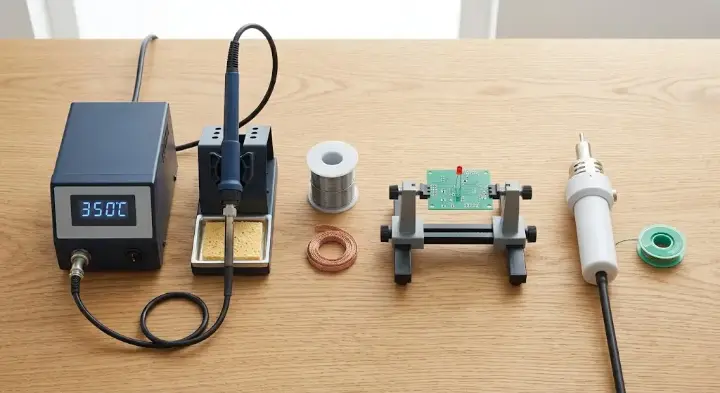
Why Precision Soldering Tools Aren't Optional
Soldering is a heat-transfer problem before it's anything else. The iron needs to bring the joint to the right temperature fast enough that the solder flows cleanly, without lingering so long that it damages a component or lifts a pad off the board. A basic fixed-wattage iron can do this for simple through-hole work. Once the job involves SMD components, heat-sensitive parts, or repeated professional use, the margin for error shrinks — and that's exactly where precision soldering tools stop being a luxury and start being the difference between a working board and a damaged one.
Temperature Control: The Single Biggest Factor
A fixed-wattage iron applies the same heat regardless of what it's touching — fine for a simple wire joint, risky for a small SMD pad or a heat-sensitive component that can be damaged by too much heat for too long.
- The ATTEN® ST-80 Digital Soldering Station (80W) covers a 150°C–480°C adjustable range, letting the temperature be matched to the job rather than left fixed — lower heat for delicate components, higher heat for larger joints that need to reach temperature quickly.
Matching temperature to the component isn't a nice-to-have for professional work — it's what keeps repeated rework from slowly damaging a board.
Tip Quality and Maintenance Matter More Than Most Beginners Expect
A soldering iron's tip is the actual point of contact for every joint, and a worn, oxidized, or wrong-shaped tip undermines even a good soldering station.
- Genuine replacement tips — like the ATTEN® TIP T900 series in flat, round, and needle shapes — keep heat transfer consistent, unlike a degraded tip that struggles to hold temperature at the actual joint.
- The ATTEN® GT-6080 Intelligent Sensor Automatic Soldering Tip Cleaner removes oxidation and residue automatically between joints — a detail that matters more over hundreds of joints in a session than any single one.
A quality tip on a cheap iron will usually outperform a worn tip on an expensive one — tip care is one of the most overlooked parts of consistent soldering.
Holding the Work Steady: Why a PCB Holder Isn't Just Convenience
Soldering with one hand holding the iron, one holding the solder wire, and nothing holding the board is a common recipe for a shaky, inconsistent joint.
- The Pro'sKit® SN-390 Adjustable Soldering Clamp Holder fixes a PCB in place so both hands stay free for the actual joint — a small addition that measurably improves joint consistency, especially on smaller boards where a slight shift can ruin a connection mid-solder.
Fixing Mistakes: Desoldering Tools Matter As Much As Soldering Ones
Every soldering job eventually needs to undo a joint — a wrong component, a cold joint, or a board that needs rework. Doing this cleanly, without damaging the pad, needs the right tool rather than just extra heat and force.
- Solder wick — like the ATTEN® AT-Series Solder Wicker in multiple widths (1.5mm to 3.5mm) — draws molten solder off a joint by capillary action, the standard method for clean through-hole desoldering.
- For SMD work, a Pro'sKit® SS-979H 2-in-1 SMD Hot Air Rework Station applies controlled hot air to lift surface-mount components without the risk of dragging a standard iron across delicate SMD pads.
Why the Brand Behind the Tool Actually Matters
A soldering iron and a cheap unbranded equivalent can look nearly identical on a listing page — similar wattage, similar shape — but temperature stability, tip longevity, and build quality diverge quickly in daily use. RAM Electronics stocks this category with established, recognized brands — ATTEN®, Pro'sKit®, SUNKKO®, and FNIRSI® — rather than unbranded generic imports, specifically because consistent results depend on consistent equipment, not just a spec sheet that looks similar on paper.
For lighter, occasional use, a simpler option still has its place — the SE830 30W Basic Soldering Iron covers straightforward through-hole work without the cost of a full digital station. The point isn't that every job needs professional-grade equipment — it's that the right tool should match the job, from a basic fixed-wattage iron for simple work up to a temperature-controlled station for anything more demanding.
Frequently Asked Questions
Why does soldering iron quality actually matter if the technique is the same?
Technique controls how you solder; the tool controls how consistently that technique translates into a reliable joint. A stable temperature, a well-maintained tip, and a steady workpiece all reduce the variables that cause cold joints, damaged components, or lifted pads — even with correct technique.
What temperature should I solder at?
It depends on the component and solder type, but a common range for general electronics work is roughly 300°C–370°C for standard leaded solder, adjusted lower for heat-sensitive components. An adjustable station like the ST-80 (150°C–480°C) lets that range be matched to the actual job instead of using one fixed setting for everything.
Do I need a hot air rework station, or is a soldering iron enough?
A standard iron covers most through-hole and simple SMD work. A hot air rework station becomes useful once the work involves removing or placing small surface-mount components, where a standard iron tip can't apply heat evenly across the part.
How do I fix a soldering mistake without damaging the board?
Solder wick is the standard tool for through-hole desoldering — it draws molten solder away from a joint by capillary action without excess heat or force. For SMD components, a hot air rework station lifts the part cleanly instead of dragging a standard iron tip across small, closely-spaced pads.
How often should I clean my soldering iron tip?
Regularly during use — oxidation and residue build up on a tip quickly and reduce heat transfer to the joint. An automatic tip cleaner like the GT-6080 makes this a quick, consistent step between joints rather than an afterthought.
Get the Right Tools for the Job
Precision soldering isn't one tool — it's a temperature-controlled iron, a well-maintained tip, a steady work holder, and the right desoldering tool when something needs to come back apart. RAM Electronics carries all of it, from ATTEN® and Pro'sKit® professional stations to simpler options for everyday work, so the results depend on the joint, not the equipment.