
Product Introduction
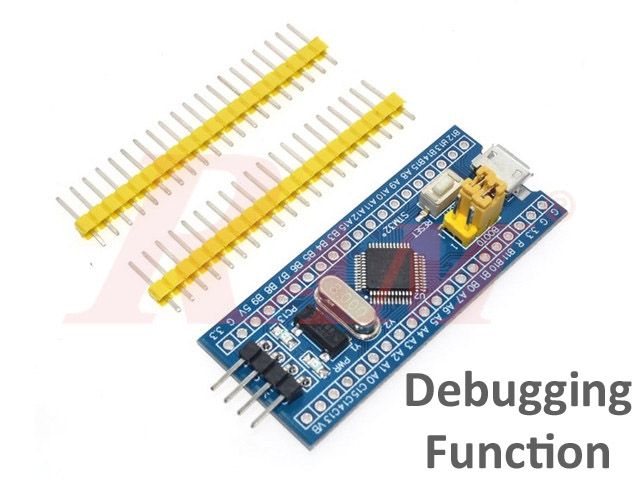
This is a core chip based on STM32F103C8T6 ARM core board.
Features
- The board is based on the most basic MCU circuit, 8Mhz crystal circuit, and USB power supply circuit.
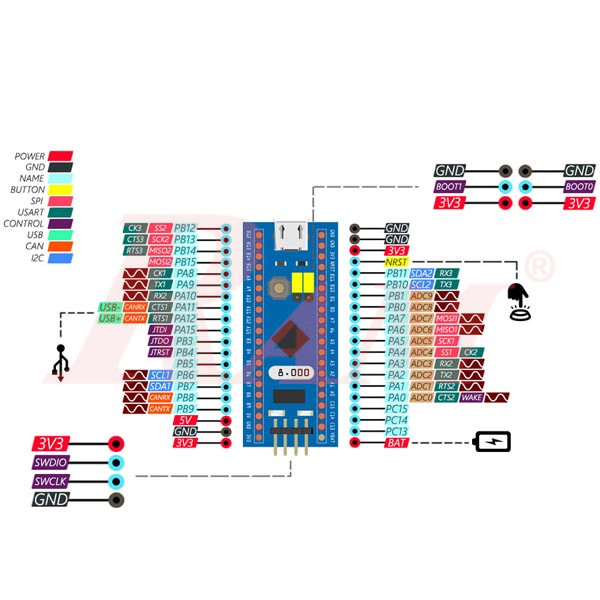
- The core board is divided into two rows leading to all the I / O ports.
- With SWD simulation debug download interface, simple and convenient, debugging speed.
- The use of the Mirco USB interface, you can do USB communication and power supply, The USB interface, is compatible with the ordinary mobile phone charger interface.
- RTC Crystal is easy to start and more stable.
- Keil can be used to compile, and IAR compile can be downloaded through the JLink or USART1 procedures, the procedures are the owner and debugging procedures.
Chip Description
- STM32F103C8T6
- Package Type: LQFP
- Number of pins: 48
- Kernel: ARM Cortex-M3
- Operating frequency: 72MHz
- Storage resources: 64K Byte Flash, 20KByte SRAM
- Interface Resources: 2x SPI, 3x USART, 2x I2C, 1x CAN, 37x I / O ports,
- Analog-to-digital conversion: 2x ADC (12-bit / 16-channel)
- Timers: 3 general timers and 1 advanced timer
- Debug Download: Support JTAG / SWD debug interface to download, support for IAP.
- RT9193: 3.3V regulator chip, a maximum output of 300mA.
Interface Description
- SWD interface: support for simulation, download and debug.
- Mirco USB interface: power supply and USB communication, do not support the download.
- USART1 interface: USART1 can be used to download the program, or use the USART1 for communication.
- MCU pin interface: leads all I / O port pins, easy to connect with peripherals.
- 5, 5V, and 3.3V power input and output interface: commonly used in external power supply, or with other modules for common ground treatment.
Other Device Description
- Power LED (PWR): Power indicator status, can determine whether the power supply is stable.
- The user LED (PC13): to facilitate the I / O output test or indicate the program running.
- Start jumping choose programming mode: (1, the user flash memory 2, SRAM 3, system memory).
- Reset button: reset chip for the user program.
- 8M Crystal: The frequency can be set to make the system clocked at 72MHz.
- 32.768KHz Crystal: Available for built-in RTC, or for calibration.
Why Choose This STM32F103C8T6 Board?
- Built around a genuine STM32F103C8T6 chip — a 72MHz ARM Cortex-M3 core with 64KB flash and 20KB SRAM, well beyond what 8-bit boards like Arduino UNO/Nano offer.
- The widely-known "Blue Pill" design, with an enormous base of tutorials, forum support, and third-party libraries built specifically around this exact board.
- Rich peripheral set for its price point — 2× SPI, 3× USART, 2× I2C, 1× CAN, and 37 I/O pins on a single small board.
- SWD debug interface built in for real step-by-step debugging (breakpoints, register inspection) — a level of debugging most 8-bit Arduino boards don't offer at all.
- Note: the onboard Micro USB port is power/communication only and does not flash the board — programming needs the SWD interface (with an ST-Link V2 programmer) or the USART1 bootloader.
Common Uses for This Board
- Learning ARM Cortex-M3 development and real hardware debugging beyond what 8-bit Arduino boards support.
- Motor control and robotics projects needing more timers, ADC channels, or CAN-bus connectivity.
- Sensor hubs and data-acquisition projects using the board's multiple I2C/SPI/USART interfaces at once.
- Low-cost prototyping for products that will later move to a custom STM32-based PCB.
- Replacing an Arduino UNO/Nano in projects that have outgrown 8-bit performance or pin count.
- Browse RAM Electronics' full range of STM development boards and microcontroller kits for related modules.
Frequently Asked Questions
Why is this board called the "Blue Pill"?
"Blue Pill" is the maker-community nickname for this specific STM32F103C8T6 minimum-system board design, named for its blue PCB color — it's not a separate product, just the common name for this exact board.
Can I program this board over the Micro USB port like an Arduino?
No — the onboard Micro USB is for power and USB communication only. Programming requires the SWD debug interface (with a tool like an ST-Link V2 programmer) or the USART1 serial bootloader.
Can I use the Arduino IDE with this board?
Yes, with the STM32 board support package added to the Arduino IDE — RAM's own STM32F103C8T6 Blue Pill Arduino guide walks through the setup.
What's the difference between this board and an Arduino UNO?
This board uses a 32-bit ARM Cortex-M3 at 72MHz with 64KB flash and 37 I/O pins, versus the UNO's 8-bit ATmega328 at 16MHz with 32KB flash and 20 I/O pins — significantly more processing power and peripherals, at the cost of a steeper learning curve and the need for a separate SWD programmer.
Ready to move beyond 8-bit Arduino boards? Shop the STM32F103C8T6 "Blue Pill" development board at RAM Electronics — genuine chip, SWD debugging, and a rich peripheral set for ARM Cortex-M3 projects.
Download