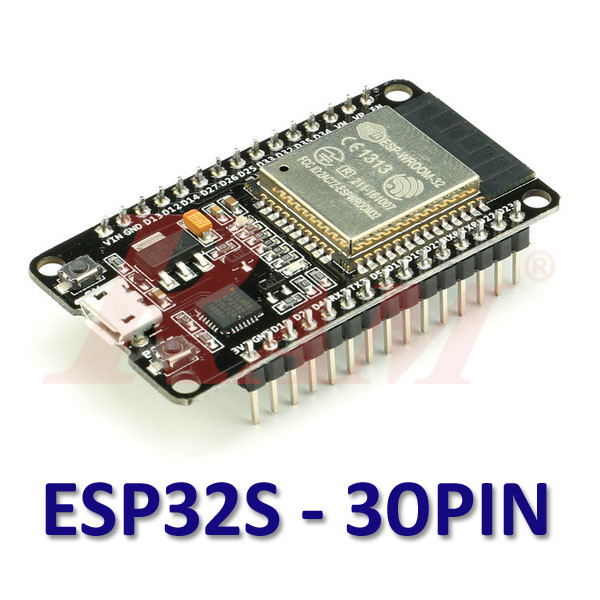
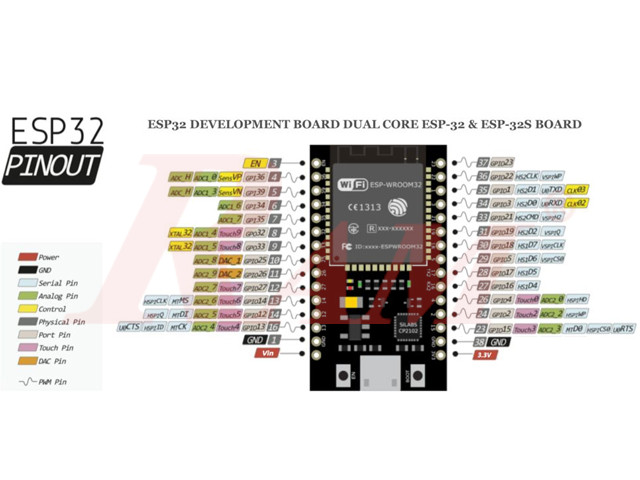
The ESP-32S 30-Pin Development Board is a compact and affordable IoT board based on the ESP32 SoC. It offers WiFi and Bluetooth connectivity, dual-core processing, and is equipped with the CP2102 USB-to-Serial interface for smooth programming and debugging. Ideal for space-constrained projects and basic ESP32 applications.
Technical Specifications
- Chipset: ESP32 (ESP-WROOM-32 Module)
- USB Interface: CP2102 USB-to-Serial chip
- Processor: Dual-core Xtensa® 32-bit LX6, up to 240 MHz
- Wireless Connectivity: WiFi 802.11 b/g/n; Bluetooth v4.2 BR/EDR + BLE
- Flash Memory: 4 MB
- GPIO Pins: 30 pins (with access to key ESP32 peripherals)
- Interfaces: UART, SPI, I²C, I²S; ADC (12-bit), DAC (8-bit), PWM
- Operating Voltage: 3.3V
- Power Input: 5V via Micro USB
- Onboard Features: Reset & Boot buttons, voltage regulator, power LED
- Board Size: Approx. 51 × 25 mm
- Development Support: Arduino IDE, ESP-IDF, MicroPython, PlatformIO
- Applications: IoT devices, home automation, wireless sensors, Bluetooth applications
Why Choose This ESP32 Development Board?
- The CP2102 USB-to-Serial chip is a more stable, widely-supported alternative to some cheaper CH340-based boards — fewer driver headaches when flashing code.
- Full dual-core ESP32 processing with both WiFi and Bluetooth on one small board — no need for separate wireless modules.
- Broad development support (Arduino IDE, ESP-IDF, MicroPython, PlatformIO) means it fits whichever workflow you already use.
- Compact 51×25mm size fits inside small enclosures where a full-size dev board wouldn't.
- Need more GPIO pins? The ESP-32S 38Pin Development Board uses the same chipset with more pin access. For a smaller footprint, the ESP32-C3 Super Mini Board trims the size down further.
Common Uses for This ESP32 Board
- Home automation nodes — smart switches, sensors, and WiFi-connected relays.
- Wireless sensor projects (temperature, humidity, motion) reporting over WiFi or Bluetooth.
- Bluetooth-connected gadgets and simple wearables.
- Learning and prototyping ESP32 projects before scaling up to a production board.
- Camera-based IoT projects — pairs with the ESP32-CAM Development Board for image capture and streaming.
- Browse RAM Electronics' full range of ESP32 & ESP8266 boards and IoT devices for related modules.
Frequently Asked Questions
What's the difference between the CP2102 and CH340 versions of ESP32 boards?
Both are USB-to-serial chips used for programming the board over USB. The CP2102 (used on this board) is generally considered more stable across different operating systems, with more consistent driver support than some CH340-based alternatives.
Can I program this board with Arduino IDE?
Yes — it supports Arduino IDE, along with ESP-IDF, MicroPython, and PlatformIO, so it fits most common ESP32 development workflows.
Does this board support both WiFi and Bluetooth at the same time?
Yes — the ESP32 SoC supports WiFi 802.11 b/g/n and Bluetooth v4.2 BR/EDR + BLE, and both can be used in the same project, though managing both simultaneously does share the chip's processing resources.
Is 4MB of flash memory enough for most ESP32 projects?
For most IoT, home automation, and sensor projects, yes — 4MB is the standard flash size for entry-level ESP32 boards and comfortably fits typical firmware plus some data storage (like web assets for a simple web server).
Looking for a reliable, compact ESP32 board for your next IoT project? Shop the ESP-32S 30-Pin Development Board with CP2102 at RAM Electronics — dual-core, WiFi + Bluetooth, and ready for Arduino, ESP-IDF, or MicroPython.