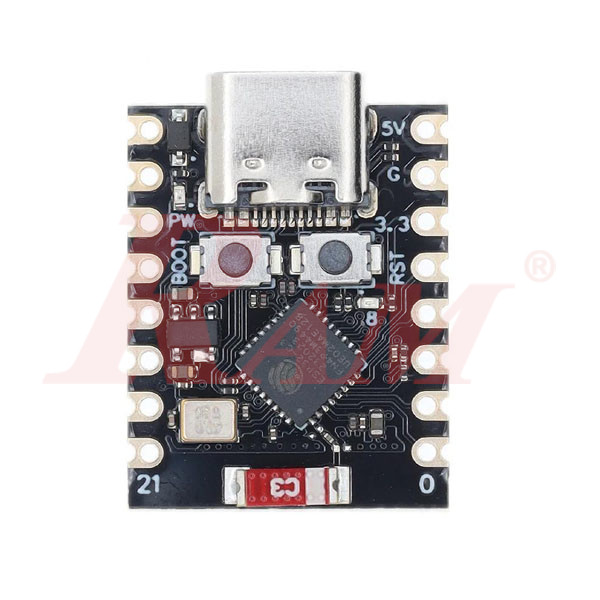
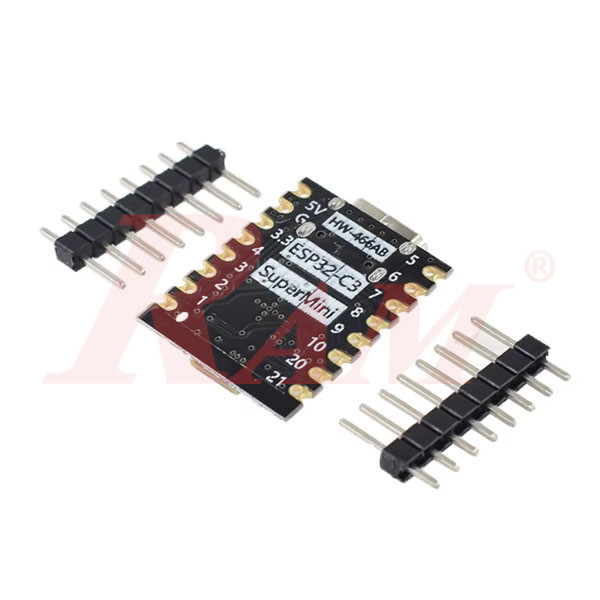
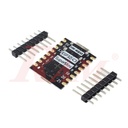
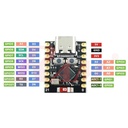
The ESP32-C3 SuperMini is a compact, powerful IoT module featuring Wi-Fi and Bluetooth 5.0 LE. It offers low power consumption, advanced security with secure boot and Flash encryption, and flexible connectivity options like GPIO, SPI, I2C, and UART. Ideal for smart devices and IoT projects, it supports easy development with ESP-IDF and Arduino IDE.
Features
- ESP32C3 SuperMini is an IoT mini development board based on the Espressif ESP32-C3 WiFi/Bluetooth dual-mode chip.
- ESP32-C3 is a 32-bit RISC-V CPU, including FPU (Floating Point Unit), which can perform 32-bit single-precision operations and has powerful computing capabilities.
- It has excellent radio frequency performance and supports IEEE 802.11 b/g/n WiFi and Bluetooth 5 (LE) protocols.
- The board comes with an external antenna to enhance signal strength for wireless applications.
- It also has a small and exquisite appearance combined with a single-sided surface mount design.
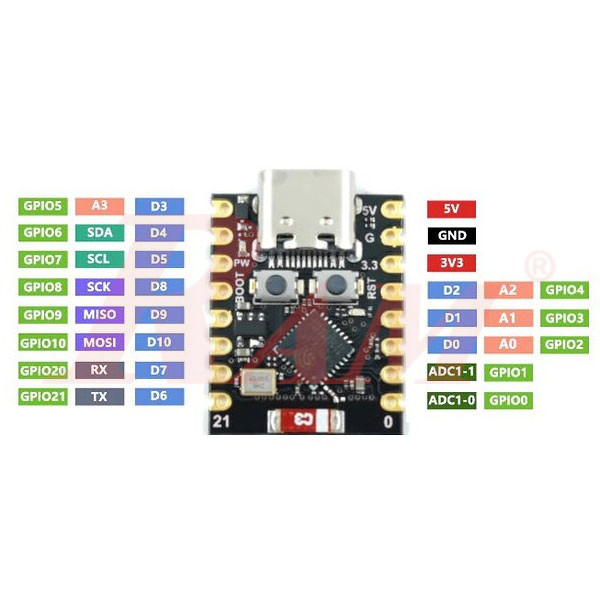
- It is equipped with rich interfaces, with 11 digital I/Os that can be used as PWM pins and 4 analog I/Os that can be used as ADC pins.
- It supports four serial interfaces including UART, I2C and SPI.
- There is also a small reset button and a bootloader mode button on the board.
- ESP32-C3 SuperMini is positioned as a high-performance, low-power, cost-effective IoT mini development board, suitable for low-power IoT applications and wireless wearable applications.
Specifications
- CPU: ESP32-C3, 32-bit RISC-V single-core processor
- Operating frequency: 160 MHz
- SRAM: 400KB
- ROM: 374KB
- ADC: 2×12-bit SARADC, 6 channels
- WiFi: 802.11b/g/n protocol, 2.4GHz, supports Station mode, SoftAP mode, SoftAP+Station mode, mixed mode
- Bluetooth: BT 5.0
- Power consumption: Deep sleep power consumption is about 43μA
- Rich on-chip resources: 400KB SRAM, 384KB ROM
- Rich interfaces: 1×I2C, 1×SPI, 2×UART, 11×GPIO (PWM), 4×ADC
- Single-sided component, surface mount design
- Classic form factor for wearables and small projects
- Robust security features: Crypto hardware accelerator supporting AES-128/256, hashing, RSA, HMAC, digital signatures and secure boot
- Onboard LED blue light, GPIO8 pin
- Size: 22.52×18mm
Why Choose the ESP32-C3 Super Mini?
- A genuine RISC-V core (rather than the Xtensa architecture used in most ESP32 boards) — useful for projects specifically targeting RISC-V toolchains.
- One of the smallest ESP32-family boards available, at just 22.52×18mm — fits inside enclosures a standard-size dev board never could.
- Deep sleep current of only ~43μA makes it a strong fit for coin-cell or small-battery wearable projects where every microamp matters.
- Need more GPIO or a bigger dev-board footprint instead? The ESP-32S 30Pin and ESP-32S 38Pin boards trade the tiny size for more pin access.
Common Uses for the ESP32-C3 Super Mini
- Wireless wearables and small battery-powered sensors.
- Compact smart-home nodes hidden inside light switches, outlets, or small enclosures.
- Low-power IoT sensors that spend most of their time in deep sleep, waking briefly to transmit data.
- Learning RISC-V embedded development on real, WiFi/Bluetooth-capable hardware.
- Browse RAM Electronics' full range of ESP32 & ESP8266 boards and IoT devices for related modules.
Frequently Asked Questions
What's the difference between ESP32-C3 and a standard ESP32 board?
The ESP32-C3 uses a RISC-V single-core CPU instead of the Xtensa dual-core architecture found in boards like the ESP-32S — it trades one CPU core for a smaller size, lower power draw, and RISC-V architecture support, while keeping WiFi and Bluetooth connectivity.
Is the ESP32-C3 Super Mini good for battery-powered projects?
Yes — its deep sleep current of about 43μA is well-suited to coin-cell or small-battery wearables and sensors that spend most of their time asleep and wake briefly to take a reading or send data.
Can I program the ESP32-C3 Super Mini with Arduino IDE?
Yes — it supports both Arduino IDE and ESP-IDF for development, the same as most other ESP32-family boards.
Does the small size limit how many GPIO pins are available?
Somewhat — it offers 11 digital I/O (PWM-capable) and 4 analog I/O (ADC) pins, fewer than larger boards like the ESP-32S 38Pin. For projects needing more pins, a larger board is a better fit.
Building a small, low-power, or wearable IoT project? Shop the ESP32-C3 Super Mini Board at RAM Electronics — a genuine RISC-V core with WiFi and Bluetooth 5.0 in one of the smallest ESP32-family footprints available.