

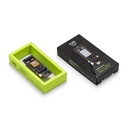


Arduino Shield Portenta CAT.M1/NB IoT GNSS
Add cellular connectivity and satellite positioning to your Portenta project with the Arduino Portenta CAT.M1/NB-IoT GNSS Shield — a low-power module supporting both CAT.M1 and NB-IoT networks alongside GPS, GLONASS, Galileo, and BeiDou positioning, ready for remote monitoring and asset-tracking builds.
Internal Reference:
ARDUINO.ORG.PORTENTA.CAT.M1
Overview
The Arduino Portenta CAT.M1/NB-IoT GNSS Shield adds cellular connectivity and location tracking to any Portenta board, turning it into a complete remote monitoring or asset-tracking solution. Built around a Cinterion TX62 wireless module from Thales, it's designed specifically for low-power IoT applications that need to stay connected over cellular networks without draining a battery quickly.
Rather than being tied to a single Portenta model, this shield lets you add or remove cellular and positioning capability without changing your main board — useful if you're prototyping with one Portenta variant now but expect to switch models later in development.
Cellular Connectivity: CAT.M1 and NB-IoT
This shield supports both CAT M1 and NB-IoT cellular protocols (3GPP Release 14 compliant), giving you flexibility depending on network availability and how much bandwidth your project actually needs. CAT.M1 offers higher throughput (up to 300 kbps download, 1.1 Mbps upload) for applications sending more data, while NB-IoT trades speed for even lower power draw and better coverage in areas with weak signal — a common trade-off in industrial and agricultural deployments where cell towers are sparse. The shield also supports SMS messaging in both text and PDU modes, useful as a lightweight fallback communication method.
Built-In Positioning: GNSS Support
Beyond cellular connectivity, this gnss module supports four positioning systems — GPS, GLONASS, Galileo, and BeiDou — so your project isn't limited to a single satellite network. That flexibility matters for asset tracking across different regions, since satellite coverage and accuracy can vary depending on where in the world a device operates. Combined with the cellular link, this makes the shield practical for tracking equipment, vehicles, or containers across cities or internationally.
Where This Shield Fits: Typical Applications
- Asset tracking for logistics, shipping containers, or vehicle fleets
- Remote environmental or equipment monitoring in agriculture
- Industrial IoT deployments where WiFi coverage isn't available
- Smart city infrastructure monitoring (utilities, public sensors)
- Building a compact multiprotocol router combining WiFi, Bluetooth, and cellular on one system
Board Compatibility
This shield is built for the Portenta family, and according to its own listed specifications, it's also compatible with Arduino MKR-series boards — including the Arduino MKR WAN 1310, which we carry as a LoRaWAN-focused alternative for projects that don't need cellular connectivity specifically.
Technical Specifications
Category | Details |
Wireless Module | Cinterion TX62 (Thales) |
Protocols | NB-IoT, LTE CAT M1/NB1/NB2 (3GPP Rel.14) |
CAT.M1 Speed | Down: up to 300 kbps / Up: up to 1.1 Mbps |
NB1 Speed | Down: up to 27 kbps / Up: up to 63 kbps |
NB2 Speed | Down: up to 124 kbps / Up: up to 158 kbps |
SMS Support | Point-to-point MT/MO, Text and PDU modes |
Positioning | GPS, GLONASS, Galileo, BeiDou |
Networking | IPv4/IPv6, TCP/UDP, DNS, HTTP, FTP, MQTT, TLS/DTLS, Secure Boot |
Dimensions | 66 × 25.4 mm |
Operating Temperature | -40°C to +85°C |
Frequently Asked Questions
What's the difference between CAT.M1 and NB-IoT on this shield?
CAT.M1 offers higher data speeds, suited to applications sending more frequent or larger data. NB-IoT is slower but more power-efficient and often has better coverage in remote areas — the shield supports both, so you can choose based on your network and power needs.
Do I need a separate GPS module for location tracking?
No, GNSS positioning (GPS, GLONASS, Galileo, BeiDou) is built into this shield alongside the cellular connectivity.
Is this shield compatible with boards other than Portenta?
Yes, it's also compatible with Arduino MKR-series boards, including the MKR WAN 1310.
Does this shield work worldwide?
Coverage depends on your local cellular network supporting CAT.M1/NB-IoT and the availability of a SIM plan for those networks in your region — check with your local carrier before deployment.
What security features does this shield support?
It includes TLS/DTLS secure connections and secure boot, relevant for IoT deployments transmitting sensitive data over cellular networks.
For more detailed technical documentation, see Arduino's official Portenta CAT.M1 product page. Browse our full Arduino Boards & Shields collection for more compatible boards and accessories.
For more information: