By Eng. Mahmoud Hamdy, CEO of RAM Electronics
To choose an oscilloscope, match three specs to the work you do: bandwidth (aim for about 5× your fastest signal), sample rate (at least 5× the bandwidth), and channels (2 for most work, 4 for digital buses). For most hobbyists, students, and labs, a 2-to-4-channel scope at 100 MHz is the sweet spot.
That one line answers most of the question. The rest of this guide gives you the full decision framework, the ten specs that matter and what each one means in practice, and the best pick for your level and budget.
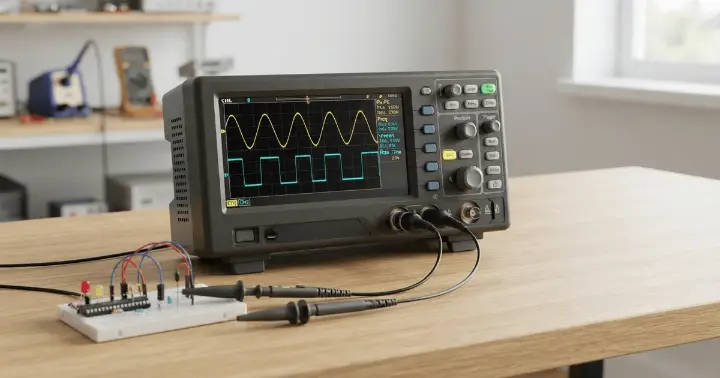
How Do You Choose an Oscilloscope?
Start with what you will actually measure, not with a spec sheet. Three questions decide almost everything:
- What signals do you work with? Audio, microcontrollers, and power supplies live below a few MHz, so 100 MHz is plenty. Fast digital or RF work needs more bandwidth.
- How many things do you watch at once? One or two signals at a time means a 2-channel scope. Decoding a bus or comparing several lines means 4 channels.
- What is your level and budget? A beginner validating a circuit needs far less than a lab debugging a finished product.
Here is the short version by situation:
If you are… | Look for… | Good starting point |
A beginner or student | 2 channels, 50–100 MHz, simple interface | An entry scope or a 3-in-1 handheld |
A serious hobbyist or maker | 2 channels, 100 MHz, deep memory | A proven 100 MHz bench scope |
Working with digital buses | 4 channels, 100 MHz+, protocol decode | A 4-channel 12-bit scope |
On a professional bench | Higher bandwidth, 12-bit, upgrade options | A pro-series scope |
The sections below explain each spec so you can adjust this to your exact case.
The 10 Specs That Matter
Use this as a checklist. Each spec has a one-line takeaway and the detail behind it.
1. Bandwidth
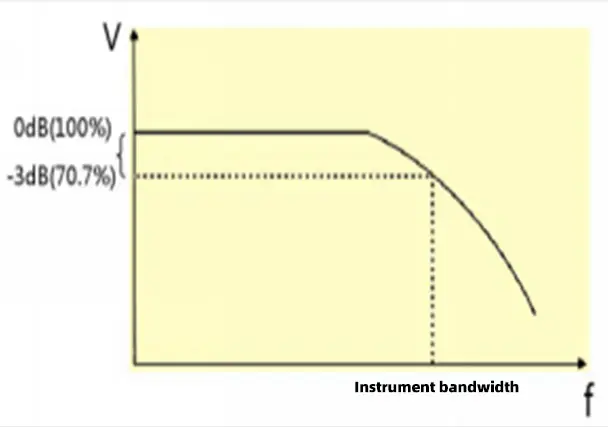
Takeaway: pick a bandwidth about five times your fastest signal. Bandwidth is the highest frequency the scope can measure accurately. At its rated bandwidth, a signal is already attenuated by about 30% (the -3 dB point), so a 100 MHz scope is honest only well below 100 MHz. The "five times rule" — a 500 MHz scope for a 100 MHz signal — keeps your readings and your edges accurate. For most microcontroller, audio, and power work, 100 MHz is more than enough.


2. Sample Rate
Takeaway: aim for at least 5× the bandwidth, and watch the per-channel rate. Sample rate is how many points per second the scope captures. Too low, and fast events are missed or aliased into false readings. Many scopes share their sample rate across channels, so turning on a second channel can halve the rate each one gets. Check the per-channel figure, not just the headline number.


3. Number of Channels
Takeaway: 2 channels for most work, 4 for digital or multi-signal projects. Two channels cover the everyday job of comparing an input and an output. Four let you watch a data bus, several clocks, or a power rail and its control signal together. More channels cost more, so buy them only if your projects need them.
4. Resolution (Bits)
Takeaway: 12-bit shows detail an 8-bit scope cannot. Resolution is how finely the scope measures voltage. Classic scopes are 8-bit; newer ones are 12-bit, which resolves small ripples, noise, and fine signal detail far better. If you work on power supplies or sensitive analog circuits, resolution matters as much as bandwidth.


5. Memory Depth
Takeaway: deeper memory lets you capture longer at full speed. Memory depth is how many points the scope stores per acquisition. It sets how long a window you can record while keeping a high sample rate. For example, 24 Mpts at 1 GSa/s captures far more of a signal than 1 Mpts at the same rate — the difference between catching a glitch inside a long event and missing it.
6. Waveform Capture Rate
Takeaway: a higher capture rate catches rare glitches. Between captures, a digital scope has "dead time" when it sees nothing. A faster waveform capture rate shrinks that blind spot, so intermittent faults are far more likely to appear on screen.

7. Triggering
Takeaway: good triggering turns a blur into a stable, readable picture. The trigger tells the scope when to start capturing, which holds the waveform still on screen. Basic edge triggering is fine for simple signals. For complex or digital signals, look for advanced triggers — pulse width, serial, pattern — so you can isolate the exact event you care about.

8. Automated Measurements
Takeaway: built-in measurements are faster and more accurate than manual cursors. A good scope reads out frequency, rise time, peak-to-peak, duty cycle, and more at a glance. The more parameters it measures automatically, the less time you spend working them out by hand.
9. Connectivity and Upgradability
Takeaway: USB and LAN save work, and an upgradable scope lasts longer. USB and LAN let you save screenshots and waveforms and control the scope from a PC. A scope whose bandwidth or options can be upgraded later protects your investment as your projects grow.
10. Cost and Value
Takeaway: buy for the work you do now, with a little headroom. Do not overpay for bandwidth you will never use, and do not buy so cheap that you outgrow it in a month. The right scope matches your current work and leaves a little room to grow.
What's the Best Oscilloscope for You?
Here is how those specs map to a real choice. RAM Electronics stocks instruments across the range, so there is a fit for every level.
- Best entry point (beginner or portable): the FNIRSI DST210 3-in-1 handheld combines a small oscilloscope, a multimeter, and a signal generator. It will not replace a bench scope, but it is the most affordable way to start seeing signals.
- Best all-round value (hobbyist or lab): the Rigol DS1102Z-E is a 2-channel, 100 MHz scope with deep memory — a long-time favorite that handles the vast majority of projects.
- Best for digital and fine detail: the Rigol DHO814 adds a fourth channel and 12-bit resolution, so you can watch several signals at once and resolve detail an 8-bit scope misses.
Not sure where a scope fits among your other tools? See our guide on how to build your electronics test bench, and, for the signal source that pairs with a scope, what a function generator does.
Frequently Asked Questions
What bandwidth oscilloscope do I need?
Aim for about five times the fastest frequency you measure. For microcontrollers, audio, and power work, 100 MHz is plenty. Only fast digital or RF work needs more.
Is a 2-channel oscilloscope enough?
For most people, yes. Two channels cover comparing an input and an output. Choose four channels when you need to watch a data bus or several signals at the same time.
What is the difference between an 8-bit and a 12-bit oscilloscope?
Resolution. A 12-bit scope measures voltage far more finely than an 8-bit one, so it shows small ripples, noise, and fine detail that an 8-bit scope blurs. It matters most for power and sensitive analog work.
What sample rate do I need?
At least five times your scope's bandwidth. Also check the per-channel rate: many scopes share their sample rate across channels, so using more channels can lower the rate each one receives.
Do I need an oscilloscope as a beginner?
Not always. A multimeter answers most early questions. You need a scope once you have to see how a signal behaves over time — timing, noise, or an intermittent glitch. A handheld 3-in-1 is an affordable first step.
How much should I spend on an oscilloscope?
Enough to cover the work you do now, with a little headroom — not more. A 2-channel 100 MHz scope suits most hobbyists and labs; add channels, bandwidth, or 12-bit resolution only when your projects call for them.
Choose With Confidence (and Buy Genuine)
Choosing an oscilloscope comes down to matching bandwidth, sample rate, and channels to your work, then picking the level and budget that fit. Get those right and the rest of the specs fall into place.
One last point: with test equipment, where you buy matters as much as what you buy. A genuine unit with a real warranty and support is worth far more than a grey-market bargain. RAM Electronics is an authorized Rigol distributor in Egypt, so you get the real instrument, warranty included.
Ready to choose? Compare the Rigol DS1102Z-E and DHO814, or browse all Rigol oscilloscopes and measurement instruments at RAM Electronics.
Explore our selection of oscilloscopes at RAM Electronics store: