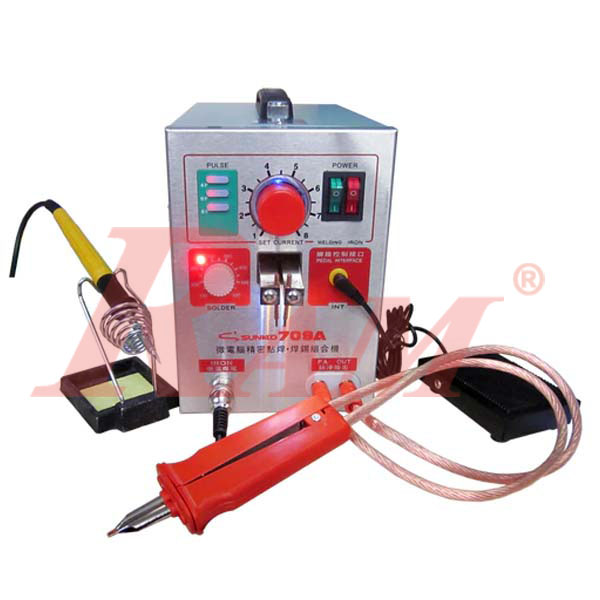
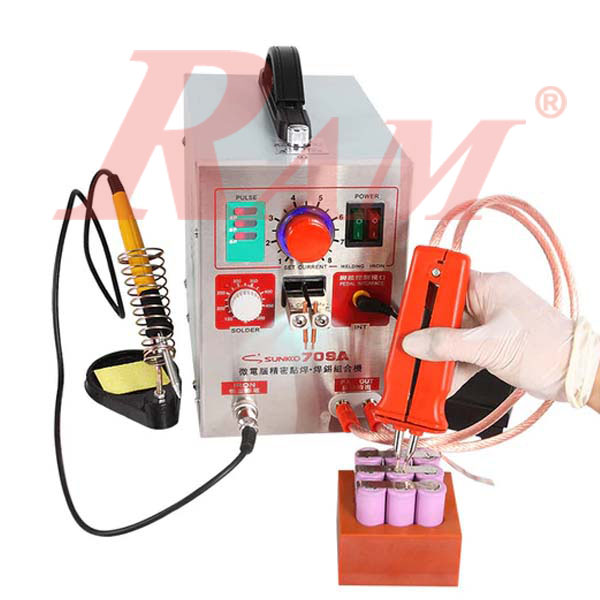
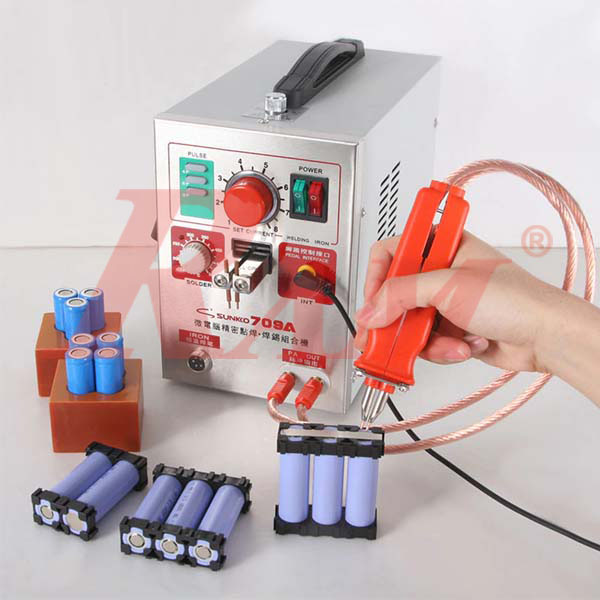
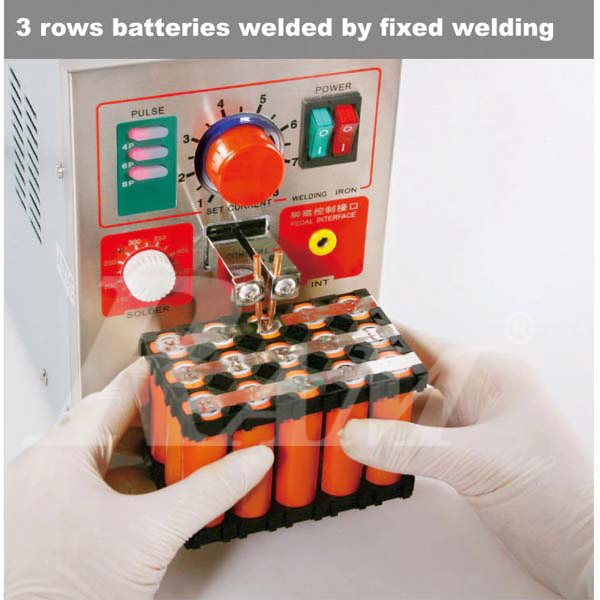
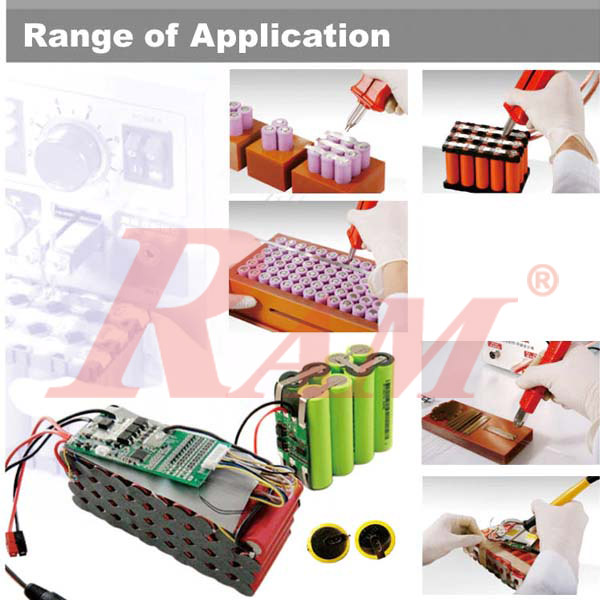
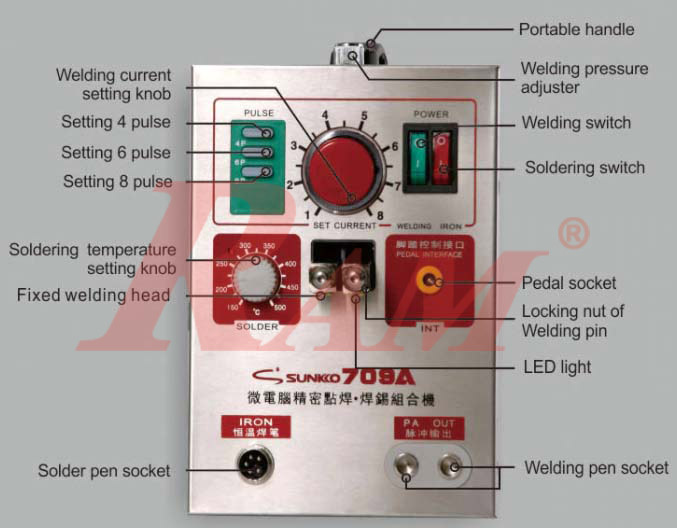


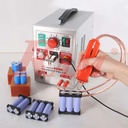
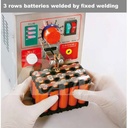
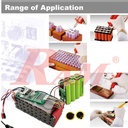
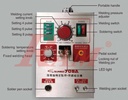
The SUNKKO 709A is a pulse spot welder built for joining nickel strips onto 18650 lithium battery cells when assembling or repairing battery packs, with a fixed welding head, a mobile welding pen, and a built-in 50W soldering iron in one unit. Instead of soldering directly onto battery terminals — which risks overheating the cell — spot welding joins the nickel strip with brief, controlled pulses of current, and this machine's adjustable pulse and current settings adapt that process to different strip thicknesses and materials.
Features
- This machine is a combination of battery spot welding and circuit board soldering, which makes you work more conveniently.
- Fixed welding head and mobile spot welding pen are combined together in one machine so that the welding will be more flexible.
- Possess the function of 2-18 welding pulses selection, which makes the soldering joint more reliable.
- Possess welding current rapid regulator, selecting the current will become quick and efficient.
- The anti-static soldering station which controls the temperature accurately,it is suited for welding any integrated circuit or wiring.
- The removable footswitches can satisfy the requirement of welding position or sophisticated technology.
- The fixed spot-welding head has a pressure-regulating device which makes the solder connections more reliable.
Basic Parameters
- Input Voltage: AC 220V
- Power: ≦3.2kw
- Output Voltage: 5V
- Output Current: 50-800A
- 2 Pulses Time: 1-10ms
- 4 Pulses Time: 2-20ms
- 8 Pulses Time: 8-80ms
Welding Thickness
Fixed Welding Head: 0.05-0.3mm(Stainless steel/iron/nickel) Welding Pen: 0.05-0.2mm(stainless steel/iron/nickel)
- Model: 709A
- Input Voltage AC 220V
- LxWxH 245mmx140mmx200mm
- Inner Package Size 320mmx180mmx320mm
- Package Size 360mmx220mmx360mm
- Fixed Welding Head: Yes
- Mobile Welding Pen: Yes
- Soldering Iron: Yes
Pulse Spot Welding Parameters
- Output Voltage 5V
- Output Current 50-800A
- 2 Pulses Time 1-10ms
- 4 Pulses Time 2-20ms
- 8 Pulses Time 8-80ms
- Welding Thickness(Fixed Head) 0.05-0.35mm(stainless steel/iron/nickel)
- Welding Thickness(Welding Pen) 0.05-0.2mm(stainless/iron/nickel)
- Soldering Iron Parameters
- Temperature Ranges 150℃-450℃
- Temperature Precision ±5℃
- Heating Time 6-8s to 300℃
- Output Voltage DC 20V
- Power 50w
Why Spot Welding Instead of Soldering Directly Onto Battery Cells?
Lithium-ion cells like the 18650 are sensitive to sustained heat — holding a soldering iron on the terminal too long can damage the cell internally, even if the outside looks fine. A dedicated 18650 battery spot welder avoids that risk: each weld pulse lasts only milliseconds (1–80ms depending on the pulse setting), joining the nickel strip to the terminal before enough heat can transfer into the cell.
- 2/4/8 pulse selection adjusts how much energy goes into each weld — fewer pulses for thin nickel strips, more pulses for thicker material or a stronger joint.
- Fixed welding head and mobile welding pen cover two different working styles: the fixed head for stable, repeatable welds on a bench, and the handheld pen for reaching cells already in a pack or an awkward position.
- Rapid current regulator lets the welding current be adjusted quickly between packs that use different nickel strip thicknesses, instead of a fixed, one-size setting.
- Removable footswitch frees both hands to hold the nickel strip and cell steady while triggering the weld.
- Compatible with common pack layouts. RAM also carries matching 2-cell and 3-cell 18650 cell spacers/holders to arrange cells before welding them into a pack.
A Spot Welder With a Built-In Soldering Iron
Building a battery pack usually needs both spot welding (for the nickel strips between cells) and regular soldering (for wiring leads, connectors, or a BMS board) — this spot welder with soldering iron covers both without a second machine on the bench. The soldering iron side runs independently of the welding function, with its own 150°C–450°C temperature range, ±5°C accuracy, and a 6–8 second heat-up time to 300°C — enough for wiring a battery management system (BMS) or connector onto a finished pack.
Frequently Asked Questions
What does the 2/4/8 pulse selection do?
It sets how many welding pulses are applied per weld, and for how long (1–10ms for 2 pulses, up to 8–80ms for 8 pulses). Fewer, shorter pulses suit thin nickel strips; more pulses deliver a stronger weld on thicker material.
Can it weld nickel strip onto 18650, 21700, or other cylindrical cells?
Yes — it's designed for the nickel strip and tab thicknesses (0.05mm–0.35mm on the fixed head, 0.05mm–0.2mm on the welding pen) commonly used across 18650, 21700, and similar cylindrical lithium cell packs. RAM's 18650 battery holders (also available in 2-cell, 3-cell, and 4-cell versions) are a simple way to hold cells steady while welding.
Is spot welding safer for lithium batteries than direct soldering?
Generally yes — spot welding applies heat for only milliseconds per pulse, reducing the risk of overheating the cell compared to holding a soldering iron directly on the terminal.
Does this machine include a soldering iron?
Yes — a 50W, temperature-controlled (150°C–450°C) soldering iron is built into the unit, separate from the spot-welding function, for wiring and connector work on the same pack.
What materials can it weld?
Stainless steel, iron, and nickel strip, within the 0.05mm–0.35mm thickness range depending on whether the fixed head or the welding pen is used.
Does it come with a footswitch?
Yes — a removable footswitch is included, letting you trigger the weld hands-free while positioning the nickel strip and cell.
Building or repairing 18650 battery packs? The SUNKKO 709A combines pulse spot welding with a built-in soldering iron in one machine — practical for battery pack assembly, e-bike and power-tool pack repair, or any DIY lithium battery project. Contact RAM Electronics to check availability.