



Product Description
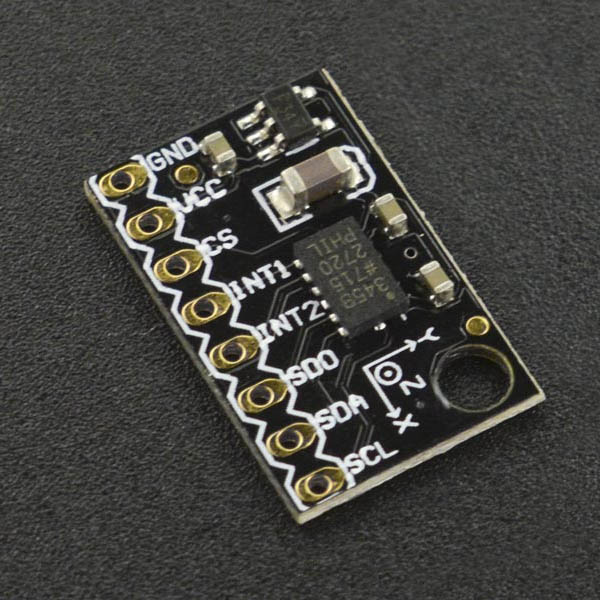
The DFRobot ADXL345 Digital Triaxial Acceleration Sensor (SEN0032) is a compact, low-power accelerometer breakout board based on the Analog Devices ADXL345 sensor. It measures acceleration along three independent axes (X, Y, and Z), making it suitable for detecting motion, tilt, vibration, shock, and changes in orientation.
The ADXL345 supports selectable measurement ranges of ±2g, ±4g, ±8g, and ±16g, with up to 13-bit resolution in full-resolution mode. Its digital output uses 16-bit two's complement data and communicates with microcontrollers through either I2C or SPI interfaces.
The sensor includes built-in motion-detection functions such as activity and inactivity detection, single and double-tap detection, and free-fall detection. It also features a 32-level FIFO buffer that can store measurement data and reduce the frequency of communication with the host controller.
With its low power consumption and compact breakout-board design, the ADXL345 is a practical choice for Arduino, ESP32, Raspberry Pi, and other embedded electronics projects.
Specifications
| Parameter | Specification |
|---|---|
| Manufacturer | DFRobot |
| Product SKU | SEN0032 |
| Sensor IC | ADXL345 (Analog Devices) |
| Sensor Type | 3-Axis Digital Accelerometer |
| Measurement Axes | X, Y, Z |
| Selectable Measurement Range | ±2g, ±4g, ±8g, ±16g |
| Resolution | Up to 13-bit (Full-Resolution Mode) |
| Sensitivity | 4 mg/LSB (Full-Resolution Mode) |
| Digital Output | 16-bit Two's Complement |
| Communication Interfaces | I2C / SPI (3-wire or 4-wire) |
| Breakout Board Working Voltage | 3.3–6V DC |
| Sensor IC Supply Voltage | 2.0–3.6V DC |
| Current Consumption | 40 µA in measurement mode; 0.1 µA in standby mode (typical at 2.5V) |
| Motion Detection | Activity / Inactivity |
| Tap Detection | Single Tap / Double Tap |
| Free-Fall Detection | Supported |
| FIFO Buffer | 32-level |
| Interrupt Outputs | 2 programmable interrupt pins |
| Board Dimensions | 20 × 15 mm |
Technical Information
1. Three-Axis Acceleration Measurement
The ADXL345 measures acceleration independently along the X, Y, and Z axes. It can detect both static acceleration, such as gravity, and dynamic acceleration caused by movement, vibration, or sudden impacts.
2. Selectable Measurement Ranges
The measurement range can be configured through the digital interface:
- ±2g
- ±4g
- ±8g
- ±16g
This flexibility allows the sensor to be configured for applications requiring either greater sensitivity to small movements or a wider acceleration range.
3. High-Resolution Digital Output
In full-resolution mode, the ADXL345 provides up to 13-bit resolution while maintaining a sensitivity of approximately 4 mg/LSB across the selectable measurement ranges. Acceleration data is provided as 16-bit two's complement values.
4. I2C and SPI Communication
The sensor supports two digital communication protocols:
- I2C: Uses SDA and SCL communication lines.
- SPI: Supports both 3-wire and 4-wire communication.
This makes it compatible with a wide range of microcontrollers and development platforms.
5. Built-in Motion Detection
The ADXL345 includes configurable detection functions:
- Activity detection: Identifies movement when acceleration exceeds a configured threshold.
- Inactivity detection: Detects when the sensor remains relatively stationary.
- Tap detection: Detects single-tap events.
- Double-tap detection: Identifies two consecutive tap events.
- Free-fall detection: Detects acceleration patterns associated with free-fall conditions.
These events can be assigned to either of the two programmable interrupt outputs.
6. FIFO Data Buffer
An integrated 32-level FIFO buffer stores measurement data before it is read by the host controller. This helps reduce processor workload and communication frequency, particularly in applications that collect motion data continuously.
Features
- Three-axis digital acceleration measurement (X, Y, and Z).
- Selectable acceleration ranges up to ±16g.
- Up to 13-bit resolution in full-resolution mode.
- High sensitivity of 4 mg/LSB in full-resolution mode.
- I2C and SPI digital communication interfaces.
- Built-in activity and inactivity detection.
- Single-tap and double-tap detection.
- Free-fall detection.
- Integrated 32-level FIFO data buffer.
- Two programmable interrupt outputs.
- Ultra-low power consumption.
- Compact 20 × 15 mm breakout-board design.
Applications
- Tilt and inclination measurement.
- Motion and movement detection.
- Vibration and shock monitoring.
- Free-fall detection systems.
- Robotics and mobile robot navigation projects.
- Gesture and tap-controlled devices.
- Portable and wearable electronics.
- Embedded systems and IoT development.
- Arduino and ESP32-based motion-sensing projects.
- Educational electronics and sensor experiments.
Frequently Asked Questions (FAQ)
1. What does the ADXL345 sensor measure?
The ADXL345 measures acceleration along three axes (X, Y, and Z). It can detect static acceleration, including gravity, as well as dynamic acceleration caused by movement, vibration, or impact.
2. What is the maximum acceleration range of the ADXL345?
The sensor supports selectable measurement ranges of ±2g, ±4g, ±8g, and ±16g, with ±16g being the maximum range.
3. Does the ADXL345 support I2C and SPI?
Yes. The sensor supports I2C communication and both 3-wire and 4-wire SPI communication, allowing it to work with different microcontrollers and development boards.
4. Can the ADXL345 measure tilt or inclination?
Yes. By measuring the gravitational acceleration components along its three axes, the sensor can be used to calculate tilt and inclination angles when the device is stationary or moving slowly.
5. Does the ADXL345 support free-fall and tap detection?
Yes. It includes built-in functions for free-fall, single-tap, double-tap, activity, and inactivity detection. These functions can be configured through its digital interface.
6. Is the ADXL345 compatible with Arduino and ESP32?
Yes. It can be interfaced with Arduino, ESP32, Raspberry Pi, and other compatible controllers through I2C or SPI. DFRobot also provides Arduino example code and a software library.
7. What is the operating voltage of this breakout board?
DFRobot specifies a working voltage of 3.3–6V DC for the SEN0032 breakout board. The ADXL345 sensor IC itself has a supply voltage range of 2.0–3.6V DC.
8. Does the ADXL345 measure angular velocity like a gyroscope?
No. The ADXL345 is an accelerometer, not a gyroscope. It measures linear acceleration along three axes but does not directly measure angular velocity. Applications requiring both acceleration and rotational motion measurement need a separate gyroscope or a combined IMU sensor.
DOCUMENTS
- DataSheet
- Wiki Doc
- Schematic
- Arduino Library (IDE 1.0 compatible)
- Product Manufacture Page