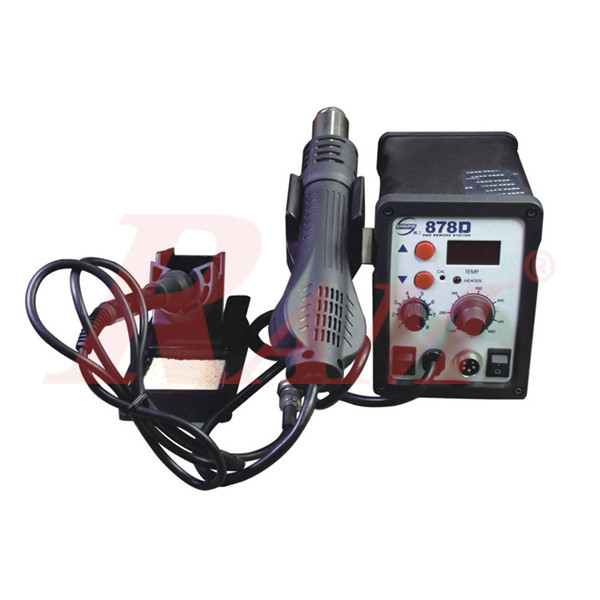
Hot Air 878D Digital Control SMD ESD + Soldering Station
Total Power 700W
Internal Reference:
HOT.AIR.878D
878D Digital Control SMD ESD Safe Hot Air + Soldering Station
The 878D is a 2-in-1 hot air rework station that combines a hot air gun and a soldering iron in one ESD-safe unit, with independent digital temperature control for each tool. Built for SMD soldering, desoldering, and general PCB rework, it covers both hand-soldering and hot-air component removal without switching between separate tools.
Features
- 2-in-1 hot air rework and soldering station
- Digital LED display for accurate temperature readings
- Independent temperature control for hot air and soldering iron
- ESD-safe design to protect sensitive electronic components
- Auto-cooling function extends the lifespan of the heating element
- Compact design ideal for bench-top use
- Suitable for lead-free soldering and SMD component repair
Specifications
- Power Input: 220V AC ±10%, 50Hz
- Total Power Consumption: 700W
- Hot Air Gun:
- Power: 650W
- Temperature Range: 100°C – 480°C
- Airflow Type: Brushless fan
- Air Volume: 120 L/min (max)
- Heating Element: Metal heater
- Handle Auto-Sleep Function
- Soldering Iron:
- Power: 50W
- Temperature Range: 200°C – 480°C
- Heating Element: Ceramic heater
- Tip Compatibility: 900M series
- General:
- Display Type: LED digital display
- Temperature Stability: ±1°C
- Noise Level: <45 dB
- Weight: Approx. 1.9 kg
- Dimensions: 150 × 130 × 100 mm
- Certification: CE compliant
Applications
- SMD soldering and desoldering (QFP, SOP, PLCC, BGA)
- Electronics repair and assembly
- Mobile phone, laptop, and gaming console servicing
- Ideal for hobbyists, repair shops, and professionals
Why a 2-in-1 Rework Station Matters for SMD Work
Reworking a modern circuit board almost always calls for two different tools: a soldering iron for through-hole joints and fine hand-soldering, and a hot air gun for lifting or reflowing surface-mount components like QFPs, SOPs, and BGAs. A 2-in-1 rework station like the 878D puts both in one unit with independent temperature control, so switching between hand-soldering a wire and reworking an SMD chip doesn't mean reaching for a second machine.
- Hot air side: 650W, 100°C–480°C range, brushless fan delivering up to 120 L/min — enough airflow and heat range for most SMD rework without overheating small components.
- Soldering iron side: 50W ceramic heater, 200°C–480°C range, compatible with common 900M-series tips — widely available and easy to replace.
- Independent control: adjusting the hot air temperature doesn't affect the soldering iron, and vice versa — useful when a job needs both tools within the same session.
What Does "ESD-Safe" Mean, and Why Does It Matter?
ESD (electrostatic discharge) can silently damage sensitive components — microcontrollers, memory chips, and other ICs — even when the static shock is too small to feel. An ESD-safe soldering station is designed to prevent that static buildup from reaching the board and components during rework, which matters most when working on modern SMD electronics rather than older through-hole designs that are more tolerant of static exposure.
Who Is the 878D Rework Station For?
- Electronics repair technicians working on mobile phones, laptops, and gaming consoles that need SMD-level rework.
- PCB assembly and prototyping where both hand-soldering and hot-air rework come up in the same project.
- Engineering and technical students learning SMD soldering and desoldering as part of an electronics or embedded-systems curriculum.
- Hobbyists repairing or modifying boards that use surface-mount components too small or too densely packed for a soldering iron alone.
Frequently Asked Questions
What does "2-in-1" mean on a rework station like the 878D?
It means one unit houses both a hot air gun and a soldering iron, each with its own independent temperature control, instead of needing two separate tools for hand-soldering and hot-air rework.
What is ESD-safe, and why does it matter here?
ESD-safe design prevents static electricity from building up and discharging into sensitive components during rework — important when working on modern ICs and SMD parts that can be damaged by static a person wouldn't even feel.
What temperature is typically needed for SMD soldering and rework?
It depends on the solder and component, but hot air rework commonly falls in the 200°C–400°C range, and hand-soldering with a fine-tip iron is often done around 300°C–370°C for leaded solder or somewhat higher for lead-free. The 878D's 100°C–480°C (hot air) and 200°C–480°C (iron) ranges cover this typical working window.
Is the 878D suitable for BGA rework?
Its hot air gun covers common SMD packages including QFP, SOP, PLCC, and BGA, making it suitable for hobby and repair-shop BGA rework; more demanding production BGA work usually calls for a dedicated BGA rework station with preheating.
Does it need special soldering iron tips?
The soldering iron uses the widely available 900M-series tips, which are common and easy to source or replace.
What's the difference between using the hot air gun and the soldering iron?
The soldering iron is for direct-contact joints — through-hole components, wires, and fine hand-soldering. The hot air gun heats components without direct contact, which is what lets it lift, reflow, or remove surface-mount parts like QFPs and BGAs that a soldering iron tip can't easily reach every pin of.
Need one station for both hand-soldering and SMD rework? The 878D hot air soldering station combines independent temperature control, an ESD-safe design, and coverage for QFP/SOP/PLCC/BGA rework in one bench-top unit. Contact RAM Electronics to check availability — a practical addition to a repair bench or student electronics lab this term.