Choosing gears for robotics is one of the first real engineering decisions you make when a project moves from an idea on paper to a machine that actually moves.
The gears you pick decide whether your robot is fast enough, strong enough to lift or push a load, and smooth enough to run without stalling or stripping teeth. Pick the wrong gear ratio and a powerful motor can feel weak, while a fast motor can end up crawling.
This beginner's guide breaks down the four things that truly matter when you choose robot gears — gear type, gear ratio, material, and how well the gears fit your motor.
At a glance, four factors decide which gears are right for your build:
- Gear type — the shape of the gear and the direction it sends motion.
- Gear ratio — the trade-off between speed and torque.
- Material — plastic for light, low-cost builds; metal for heavy loads.
- Fit — whether the gear matches your motor shaft and meshes correctly with its partner gear.
Work through them in that order, and most gear problems disappear before they start.
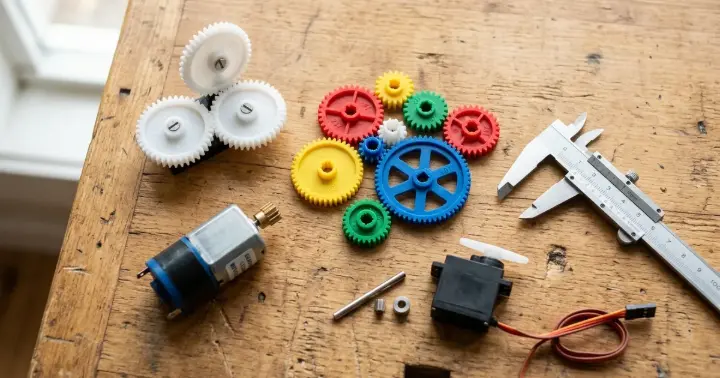
Types of Gears for Robotics
Each gear shape is built for a specific job. Knowing the main types makes it far easier to choose gears for robotics that match how your mechanism needs to move.
- Spur gears — the most common type. Straight teeth connect two parallel shafts, the default choice for simple speed and torque changes. They can get noisy at high speed.
- Crown gears — teeth on the face of the gear mesh with a spur gear (a pinion) at a right angle. They are an easy way to pass motion between two perpendicular shafts in light mechanisms. RAM Electronics stocks plastic crown gears for exactly this kind of general-purpose use.
- Bevel gears — teeth cut into a cone shape join shafts that meet at an angle, usually 90°, and handle a little more load than a basic crown gear.
- Worm gears — a screw-like "worm" drives a wheel for a very high reduction in a small space, with strong torque. They can be self-locking so the output cannot back-drive, though efficiency is lower.
- Planetary gears — small "planet" gears orbit a central "sun" gear inside a ring. They pack high torque into a compact, in-line shape, which is why they sit inside many gearmotors.
- Helical gears — like spur gears but with angled teeth, so they run more smoothly and quietly at higher speeds.
Understanding Gear Ratio: Speed vs Torque
Gear ratio is the heart of choosing gears for robotics. It comes down to one simple trade-off: you can have speed or you can have force, but not more of both at the same time.
The gear ratio is the relationship between the number of teeth on the two meshing gears. If a small 10-tooth gear on your motor drives a larger 30-tooth gear, that is a 3:1 reduction.
The output shaft then turns at one-third of the motor's speed, but with roughly three times the torque — minus a little loss to friction.
Reduction means slower output and more strength, which suits robot arms, lifts, and anything that moves a load. A lighter reduction keeps more speed, which suits wheels on flat ground.
There is no single "best" ratio — only the ratio that matches what your robot has to do.
Plastic vs Metal Gears: Which Should You Use
The material sets how much load your gears can take, how long they last, and how much they cost.
- Plastic gears — light, inexpensive, and quiet. Ideal for low-load, hands-on builds: educational robots, hobby projects, toys, and prototypes. They are also kind to your motor, because under a sudden jam a plastic tooth tends to give way before the motor overheats.
- Metal gears — brass, steel, or aluminum handle far higher loads and last longer in heavy-duty machines, at a higher cost and with more noise.
For most beginners and classroom projects, plastic is the right starting point.
RAM's plastic crown gears and its assorted mixed plastic gear set are made for this kind of light, general-purpose robotics — handy both for building a mechanism and for replacing a gear that has worn or cracked.
How to Match Gears to Your Motor
This is the step beginners skip most often, and the one that causes the most frustration. Two gears only work together if they physically fit.
- Module (tooth size) must match. Two gears mesh smoothly only when they share the same module. A fine-tooth gear will not run against a coarse-tooth gear, even if they look similar.
- The bore must fit the shaft. The hole in the centre of the gear has to match your motor's shaft diameter and shape — round, or a flattened "D". A mismatch means the gear won't fit, or spins loosely without driving anything.
- Centre distance has to be right. The shafts must sit close enough for the teeth to mesh, but not so close that they bind. Too far apart and the teeth slip; too close and they jam.
Check these three before you buy, and your gears will mesh the first time.
Which Gears for Your Project?
Here is how it all comes together for the builds beginners usually start with:
- Strong and slow — a gripper, a lifting arm, or a joint needs a higher reduction, and metal gears if the load is real. A multi-joint build like a 6-DOF robotic arm relies on this kind of torque-first gearing at every joint.
- Fast — a wheeled robot on flat ground works best with a lighter reduction, so it keeps its speed.
- From a DC motor — small DC motors spin fast with little torque, so they almost always need a reduction geartrain. A crown or spur gear is a simple way to add that first stage and, when needed, turn the drive through 90°.
- From a servo — a servo is already geared inside, so you usually add external gears only to change the direction or range of movement, such as a crown gear redirecting motion to a perpendicular shaft.
If your project runs on an Arduino UNO or a similar board, remember: the gears decide the mechanics, the board decides the timing. Matching the two is what makes a robot move the way you intended.
Frequently Asked Questions
What gear ratio do I need for my robot?
It depends on whether you need speed or strength. For a robot that lifts or pushes a load, use a higher reduction such as 3:1 or more to gain torque. For a wheeled robot that needs speed on flat ground, use a lighter reduction. Start from your motor's speed and the job the robot has to do.
Are plastic or metal gears better for robotics?
Neither is better overall — it depends on load. Plastic gears are light, quiet, affordable, and perfect for educational and hobby robots. Metal gears are for heavy or continuous loads where strength and durability matter most.
What gears work with a DC motor?
A small DC motor usually needs a reduction geartrain, because on its own it spins too fast with too little torque. Spur and crown gears are a common first stage. The key is to match the gear's bore to the motor shaft and its module to the partner gear.
What is a crown gear used for?
A crown gear passes motion between two shafts that meet at a right angle. It meshes with a spur gear and is a simple, low-cost way to turn the direction of a drive by 90° in light mechanisms and educational robots.
How do I know what size gear will fit my motor?
Check two things: the bore must match your motor's shaft diameter and shape, and the module must match any gear it meshes with. If either is wrong, the gears will not drive each other properly.
Conclusion
Choosing gears for robotics comes down to four clear questions: what type of gear fits your mechanism, what ratio balances speed and torque, what material suits your load, and whether the gears fit your motor shaft and each other.
Work through them in order, and you will avoid the mistakes that trip up most beginners — and spend your time building instead of troubleshooting.
Ready to start your first build? Browse RAM Electronics' full range of robotics parts and accessories, or go straight to our plastic crown gears and mixed plastic gear sets to pick the parts that match your robotics project.