



Arduino MKR WAN 1310 اردوينو ام كي ار وان
Need to connect sensors over long distances without relying on WiFi range? The Arduino MKR WAN 1310 pairs the SAMD21 processor with a LoRa module for Arduino projects that need to reach kilometers, not meters — with battery consumption low enough for long-term field deployment.
مرجع داخلي:
ARDUINO.ORG.MKR.WAN.1310
Overview
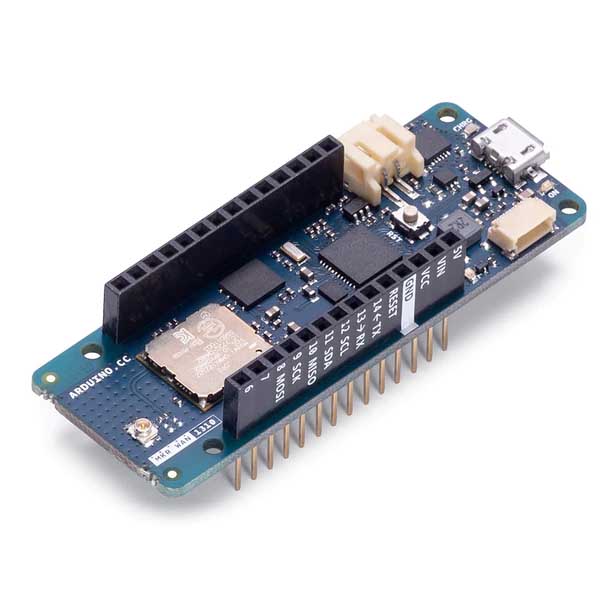
The Arduino MKR WAN 1310 is built around long-range, low-power connectivity using the LoRa® wireless protocol, making it a practical choice for IoT projects where WiFi or Bluetooth simply can't reach far enough — remote sensor networks, agricultural monitoring, or asset tracking across large outdoor areas. It's an upgraded version of Arduino's earlier MKR WAN 1300 board, keeping the same SAMD21 processor and secure element family while adding a battery charging circuit and onboard flash storage.
Power efficiency is one of this board's strongest points — properly configured, it can run on as little as 104 microamps, which translates to genuinely long battery life for a device that only needs to transmit data occasionally, like a remote sensor checking in every few minutes or hours. It can run on USB power (5V) or independently on a rechargeable battery, giving you flexibility depending on whether your project is stationary or fully portable.
Onboard Storage and Data Logging
An onboard 2MB flash chip opens up options beyond simple sensor transmission: the board can log data locally and send it later when a connection is available, store configuration files, or hold small scripts — useful for projects in areas with inconsistent network coverage. A dedicated security chip also handles credential and certificate storage, adding a layer of protection for projects transmitting data over a public LoRaWAN network.
Technical Specifications
- Microcontroller: SAMD21 Cortex-M0+, 32-bit low-power ARM MCU
- Radio Module: Murata CMWX1ZZABZ (LoRa)
- Secure Element: ATECC508
- Board Power Supply: 5V (USB/VIN)
- Circuit Operating Voltage: 3.3V
- Supported Batteries: Rechargeable Li-Ion or Li-Po, 1024mAh minimum
- Digital I/O Pins: 8
- Analog Input Pins: 7 (8/10/12-bit ADC)
- Analog Output: 1 (10-bit DAC)
- Communication: 1× UART, 1× SPI, 1× I2C
- CPU Flash Memory: 256KB (internal)
- External Flash: 2MB (QSPI)
- SRAM: 32KB
- Carrier Frequency: 433/868/915 MHz
- Antenna Gain: 2dB (bundled pentaband antenna)
- Dimensions: 67.64 × 25 mm
- Weight: 32g
Frequently Asked Questions
How is this different from a WiFi or Bluetooth Arduino board?
LoRa communication trades data speed for range — instead of tens of meters like WiFi or Bluetooth, this board can transmit over kilometers, making it suited for projects spread across a wide outdoor area rather than a single building.
Do I need a LoRaWAN gateway to use this board?
For LoRaWAN network connectivity, yes — the board needs to communicate with a gateway that forwards data to a network server. Point-to-point LoRa communication between two boards is also possible without a gateway.
Can this board run entirely on battery power?
Yes, it supports rechargeable Li-Ion or Li-Po batteries (1024mAh minimum) and includes a battery charging circuit, with power consumption low enough (as low as 104µA when properly configured) for extended field deployment.
What is the onboard flash storage used for?
The 2MB flash chip allows local data logging, storing configuration files, or holding data to transmit later when connectivity allows — useful for areas with inconsistent network coverage.
Which frequency should I use for my region?
The board supports 433/868/915 MHz depending on region — check your local LoRaWAN frequency regulations before deployment, as this varies by country.
Need shorter-range WiFi and Bluetooth instead? See our Arduino Nano 33 IoT — built on the same SAMD21 processor family. Browse our full Arduino Boards & Shields collection for more IoT-ready boards.
For more information: