Search "Arduino kit" and you'll get a dozen similarly-named boxes with no obvious difference between them. The right one depends entirely on where you are — starting your first course, moving into more advanced projects, or already owning half the basics and just needing one missing piece. Here's exactly which option fits each situation, using real kits available at RAM Electronics.
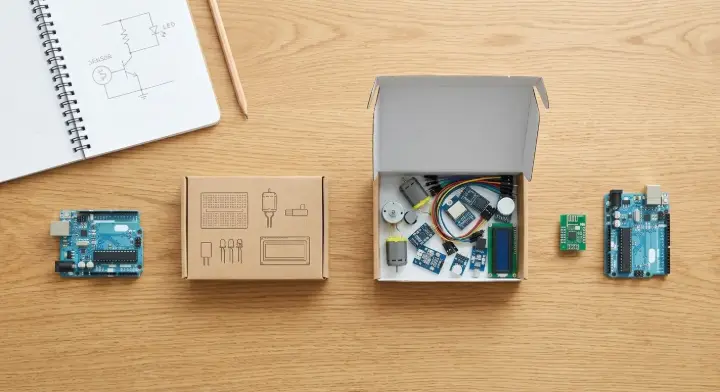
Just Need the Board? Skip the Kit
If you already own a breadboard, jumper wires, and a basic sensor or two — from an earlier purchase or a previous course — buying a full kit means paying again for parts you already have.
- The Arduino UNO Rev3 (A65) covers just the board itself: genuine MEGA16U2 and ATmega328 chips, specially manufactured for RAM Electronics rather than a generic unbranded clone.
- Pair it with a Sensor Kit 46 in 1 if you want a wide range of individual sensors to mix and match project by project, rather than a fixed kit's pre-selected set.
First Course? Start With the Basic Starter Kit
If this is your first time touching Arduino, a kit built around a structured set of first projects removes the guesswork of buying compatible parts one at a time.
- The TR-02 Arduino Basic Starter Kit includes an Arduino UNO R3 board, a USB cable, a prototype extension board, a mini breadboard, and an HC-04 ultrasonic sensor — enough to work through a first set of creative, hands-on projects without hunting down individual parts.
Ready for More? Move Up to the Advanced Kit
Once basic LED-and-sensor projects feel routine, an advanced kit adds the components needed for motor control, access systems, and motion sensing in one box.
- The TR-11 Arduino Advanced Starter Kit bundles an Arduino UNO R3 board with 75+ components — motors, an RFID module (NXP's MFRC522), a gyroscope (InvenSense's MPU-6050), an LCD screen, and more — plus a CD of guided lessons and projects.
Want to Add WiFi Early? Try the Complete Learning System
Some courses (or personal projects) call for network connectivity from the start, rather than adding it later as a separate module.
- The Arduino UNO Development & Training Complete Learning System pairs an Arduino UNO R3 (ATMEGA328P) board with a full set of accessories, including an ESP-01S WiFi module and its own USB programmer — a practical option if your projects (or coursework) move toward IoT rather than staying purely offline.
Quick Reference: Which Kit Fits You
Situation | Recommended Option | What It Adds |
Already have breadboard/wires/sensors | Just the board, genuine chips | |
Want to pick your own sensors | UNO + Sensor Kit 46-in-1 | Wide sensor range, no fixed kit |
First Arduino course | Board, breadboard, USB cable, ultrasonic sensor | |
Moving into motors/RFID/sensors | 75+ components, guided lesson CD | |
Need WiFi/IoT from the start | ESP-01S WiFi module, USB programmer |
Frequently Asked Questions
Do I need a full kit, or can I just buy the board?
If you already have a breadboard, jumper wires, and basic sensors from a previous purchase or course, the bare Arduino UNO board is enough — a full kit mainly earns its cost when you're starting from nothing.
What's the actual difference between the basic and advanced kits?
The basic kit (TR-02) covers a first set of projects with an ultrasonic sensor and breadboard basics; the advanced kit (TR-11) adds motors, an RFID module, a gyroscope, and other components for projects well beyond simple LED-and-sensor exercises.
Does any of these kits include WiFi connectivity?
The Arduino UNO Development & Training Complete Learning System includes an ESP-01S WiFi module and its own USB programmer — the other kits here focus on core Arduino projects without a built-in wireless module.
Can I buy the board and sensors separately instead of a fixed kit?
Yes — pairing the standalone Arduino UNO Rev3 with a broader sensor pack like the Sensor Kit 46-in-1 works well if you'd rather choose your own components than commit to a kit's pre-selected set.
Is a genuine Arduino UNO board necessary, or does a clone work fine for coursework?
For most coursework, what matters more than an official Arduino-brand label is genuine, quality components — RAM's UNO Rev3 (A65) uses authentic MEGA16U2 and ATmega328 chips rather than the lower-quality parts found in some unbranded clones, at a lower cost than an official board.
Ready to Start Building?
Whether you need just the board or a complete guided kit, RAM Electronics carries the full range — from a standalone Arduino UNO to advanced sensor kits and WiFi-ready learning systems — so you can match your purchase to exactly where you are this semester.