

Product Description
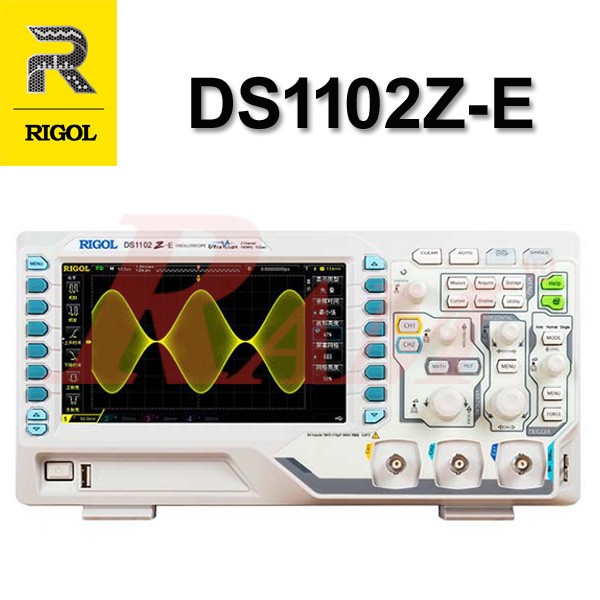
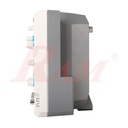
The RIGOL DS1102Z-E Digital Oscilloscope is a 2-channel digital oscilloscope designed for electronic engineers, technicians, researchers, and educational laboratories. It features a 100 MHz analog bandwidth, a maximum real-time sampling rate of 1 GSa/s, and up to 24 Mpts of standard memory depth.
Part of RIGOL's DS1000Z-E series, the DS1102Z-E is built on RIGOL's UltraVision technology, combining waveform acquisition, signal analysis, and debugging functions in a practical and economical instrument.
The oscilloscope features a 7-inch WVGA TFT LCD display with 800 × 480 resolution and intensity-graded color display, helping users visualize waveform details. It supports a maximum waveform capture rate of 30,000 wfms/s and hardware real-time waveform recording and playback of up to 60,000 frames.
Additional functions include FFT analysis, automatic measurements of 37 waveform parameters, waveform math operations, serial protocol decoding, and Pass/Fail testing. With USB Host, USB Device, LAN, and AUX interfaces, the DS1102Z-E is suitable for electronic circuit debugging, embedded systems development, signal testing, and technical education.
Specifications
| Specification | Details |
|---|---|
| Model | DS1102Z-E |
| Brand | RIGOL |
| Product Series | DS1000Z-E |
| Product Type | Digital Oscilloscope |
| Analog Bandwidth | 100 MHz |
| Analog Channels | 2 |
| External Trigger Input | Yes |
| Maximum Real-Time Sample Rate | 1 GSa/s (Single-Channel) |
| Maximum Real-Time Sample Rate | 500 MSa/s (Dual-Channel) |
| Standard Memory Depth | 24 Mpts (Single-Channel) |
| Standard Memory Depth | 12 Mpts (Dual-Channel) |
| Maximum Waveform Capture Rate | 30,000 wfms/s |
| Hardware Waveform Recording | Up to 60,000 frames |
| Standard Vertical Resolution | 8 bits |
| High-Resolution Acquisition Mode | Up to 12 bits |
| Vertical Scale | 1 mV/div to 10 V/div |
| Timebase Range | 2 ns/div to 50 s/div |
| Display Size | 7 inches |
| Display Resolution | 800 × 480 pixels |
| Display Type | WVGA TFT LCD |
| Display Colors | 16 Million Colors |
| Waveform Display | Intensity-Graded Color Display |
| Input Impedance | 1 MΩ ±1% in parallel with 15 pF ±3 pF |
| Input Coupling | DC, AC, GND |
| Standard Interfaces | USB Host, USB Device, LAN |
| Auxiliary Output | AUX (TrigOut/PassFail) |
| Power Supply | 100 V to 240 V AC, 45 Hz to 440 Hz |
| Maximum Power Consumption | 50 W |
| Dimensions | 313.1 × 160.8 × 122.4 mm |
| Weight (Without Package) | 2.9 kg ± 0.2 kg |
Sampling Rate and Memory Depth
The available sampling rate and memory depth depend on the number of active analog channels.
| Active Channels | Maximum Sample Rate | Standard Memory Depth |
|---|---|---|
| 1 Channel | 1 GSa/s | 24 Mpts |
| 2 Channels | 500 MSa/s | 12 Mpts |
Technical Information
100 MHz Analog Bandwidth
The DS1102Z-E offers a 100 MHz analog bandwidth, making it suitable for observing and analyzing electronic signals in circuit development, testing, and troubleshooting applications.
Two Analog Channels and External Trigger
The oscilloscope provides two independent analog input channels and a separate external trigger input. This allows users to monitor two analog signals simultaneously and use an external signal as a trigger source when required.
Real-Time Sampling and Memory Depth
The DS1102Z-E supports a maximum real-time sampling rate of 1 GSa/s in single-channel operation and 500 MSa/s when both channels are enabled. Its standard memory depth is 24 Mpts in single-channel operation and 12 Mpts in dual-channel operation.
Vertical Resolution and High-Resolution Mode
The standard vertical resolution is 8 bits. The oscilloscope also provides a High Resolution acquisition mode that can achieve up to 12-bit resolution, helping users improve waveform detail under suitable acquisition conditions.
UltraVision Waveform Acquisition
RIGOL's UltraVision technology provides a maximum waveform capture rate of 30,000 wfms/s in dots display mode. The oscilloscope also supports hardware real-time waveform recording and playback of up to 60,000 frames.
Trigger Functions
The DS1102Z-E supports a variety of trigger types for different signal conditions, including:
- Edge Trigger
- Pulse Trigger
- Slope Trigger
- Video Trigger
- Pattern Trigger
- Duration Trigger
- Timeout Trigger
- Runt Trigger
- Window Trigger
- Delay Trigger
- Setup/Hold Trigger
- Nth Edge Trigger
- RS232 Trigger
- I2C Trigger
- SPI Trigger
Serial Protocol Decoding
The oscilloscope supports decoding of the following communication protocols:
- Parallel
- RS232/UART
- I2C
- SPI
It also supports two bus decoding modules, allowing users to configure two decoding operations for supported input signals.
Waveform Analysis and Measurements
The DS1102Z-E includes several built-in analysis functions:
- Automatic measurement of 37 waveform parameters.
- Cursor-based measurements.
- Frequency counter measurement.
- FFT analysis.
- Waveform math operations, including addition, subtraction, multiplication, division, and filtering.
- Pass/Fail testing.
- Reference waveform comparison.
- Waveform recording and playback.
- Measurement statistics.
Features
- 100 MHz analog bandwidth.
- Two independent analog input channels.
- External trigger input.
- Up to 1 GSa/s real-time sampling rate.
- Up to 24 Mpts standard memory depth in single-channel operation.
- Up to 30,000 wfms/s waveform capture rate.
- Hardware waveform recording and playback up to 60,000 frames.
- Standard 8-bit vertical resolution with up to 12-bit High Resolution acquisition mode.
- 7-inch WVGA TFT LCD display with 800 × 480 resolution.
- Intensity-graded color waveform display.
- 1 mV/div to 10 V/div vertical scale range.
- Multiple trigger functions, including serial protocol triggers.
- Parallel, RS232/UART, I2C, and SPI protocol decoding.
- Built-in FFT analysis.
- Automatic measurement of 37 waveform parameters.
- Waveform math operations and digital filtering.
- Pass/Fail testing and reference waveform comparison.
- USB Host, USB Device, LAN, and AUX interfaces.
- Remote command control and LXI compatibility.
What Makes This 2 Channel Oscilloscope Useful?
A scope is only as useful as the signals it can show clearly, and the DS1102Z-E is built around four numbers that matter in daily work.
Bandwidth. At 100 MHz, the analog bandwidth is enough for most microcontroller, audio, power-supply and sensor signals a student or technician meets. As a common rule of thumb, bandwidth should be about five times the fastest signal you want to see, so 100 MHz suits signals up to roughly 20 MHz.
Sample rate and memory. The scope samples at up to 1 GSa/s on a single channel (500 MSa/s with both channels on) and stores up to 24 Mpts (12 Mpts with both channels on). Deep memory lets you keep a long capture at a fast sample rate, then zoom into a short glitch without losing detail.
Capture rate. With up to 30,000 waveforms per second, the display refreshes fast enough to catch short, rare events that slower scopes miss.
Display. The 7-inch WVGA screen uses graded intensity, so a signal that repeats often looks brighter than one that appears once. That makes noise, jitter and occasional faults easier to spot.
Serial Bus Decoding on This Digital Storage Oscilloscope: I²C, SPI and RS232/UART
Most modern circuits talk over serial buses, and reading them as raw pulses is slow. The DS1102Z-E includes serial bus trigger and decoding for RS232/UART, I²C and SPI, so the packets appear as readable values on the screen instead of a string of highs and lows.
In practice, this lets you:
- Check that an Arduino or STM32 board is sending the bytes you expect over UART.
- See the address and data of an I²C sensor or display, and find out whether it is answering.
- Follow SPI traffic to a memory chip or a display module while you debug your code.
The scope also offers FFT and math functions for looking at signals in the frequency domain, and hardware waveform recording and playback of up to 60,000 frames.
Who Is This 100MHz Digital Oscilloscope For?
- Engineering and technical students. A two-channel scope with decoding covers most lab work in electronics and embedded systems courses, which makes it a practical pick as the school and university year gets going.
- Repair and field service. Compact and light (2.9 kg without packaging), so it moves easily between the workshop and a customer site.
- Makers and embedded developers. Debug I²C, SPI and UART links without adding a separate logic analyzer.
- Production testing and R&D benches. Two channels are enough for comparing an input with an output or measuring timing between two signals.
What's in the Box
- RIGOL DS1102Z-E digital oscilloscope × 1
- Power cord × 1
- USB cable × 1
- Passive probes × 2
- User manual × 1
DS1102Z-E vs Other RIGOL Oscilloscopes: Which One Fits?
The DS1000Z family has both 2-channel and 4-channel models, so the right choice depends on how many signals you need to see at once.
- Choose the DS1102Z-E if you mainly compare two signals (for example, an input and an output, or clock and data) and want 100 MHz of bandwidth on a two-channel scope.
- Consider a 4-channel model such as the DS1054Z (50 MHz) or DS1104Z Plus (100 MHz) if you regularly need to watch three or four signals together, such as several phases or multiple bus lines.
- Consider a higher-bandwidth 2-channel model such as the DS1202Z-E (200 MHz) if you work with faster signals.
One more thing to plan for: the DS1102Z-E does not include a built-in signal generator. If you need test signals to feed a circuit, pair it with a function generator such as the DG1022U RIGOL 25MHz 2 Channel Function/Arbitrary Waveform Generator. For checking supply rails and component values before you probe, a UT890D+ True RMS Digital Multimeter is a useful companion.
Frequently Asked Questions
What is a digital storage oscilloscope?
It is an instrument that samples a voltage signal, stores the samples in memory, and draws the result as a waveform on a screen. Because the data is stored, you can pause, zoom, measure and save a capture, which an analog scope cannot do.
Is 100 MHz bandwidth enough?
For most student, hobby and repair work, yes. A common rule of thumb is to pick a scope with about five times the bandwidth of the fastest signal you plan to measure, so 100 MHz covers signals up to around 20 MHz. If you work with much faster signals, look at a higher-bandwidth model.
Can this oscilloscope decode I²C, SPI and UART?
Yes. The DS1102Z-E includes serial bus trigger and decoding for RS232/UART, I²C and SPI, and shows the decoded data directly on the waveform display.
How many channels does the DS1102Z-E have?
It has 2 analog channels. The sample rate is 1 GSa/s with one channel active and 500 MSa/s with both active.
Does it come with probes?
The standard package lists two passive probes, a power cord, a USB cable and a user manual.
Can I connect it to a computer?
Yes. It has USB Host and Device ports and a LAN (LXI) interface, so you can transfer captures to a computer or control it over a network.
Does it have a built-in signal generator?
No. It is a measurement scope only. Use a separate function generator if you need to create test signals.
Whether you are setting up a student lab for the new term or upgrading a repair bench, the RIGOL DS1102Z-E gives you two channels, 100 MHz of bandwidth and built-in I²C, SPI and UART decoding in a compact scope. Contact RAM Electronics to check availability and get your back-to-school RIGOL oscilloscope with a 1-year warranty.
Download