A function generator is one of the most useful instruments on a serious electronics bench — and one of the least understood by people just starting out.
In simple terms, it is a device that produces electrical signals you can control, so you can feed a known signal into a circuit and watch how the circuit responds. If an oscilloscope is the tool that reads a signal, a function generator is the tool that makes one. The two work as a pair.
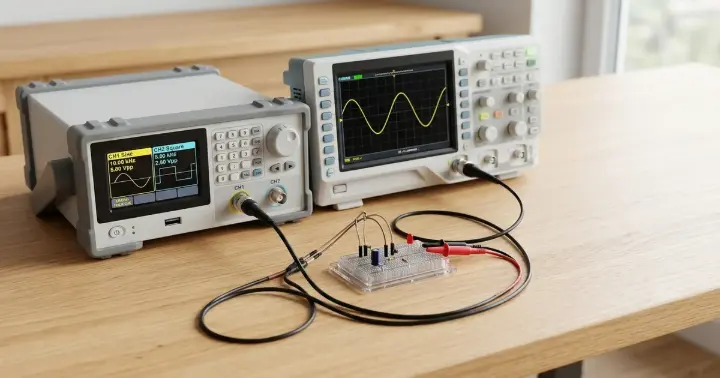
This guide explains what a function generator does, what you actually use it for, how it works with an oscilloscope, and whether you need one yet — using the RIGOL DG1022Z as a real-world example.
What Is a Function Generator?
A function generator creates repeating electrical waveforms at a frequency, shape, and amplitude you set.
The classic shapes are the sine wave, the square wave, and the ramp, plus pulses and noise. You dial in how fast the signal repeats (frequency), how big it is (amplitude), and where it sits (offset), and the generator outputs that signal continuously.
That signal becomes your test stimulus. Instead of waiting for a circuit to meet a real-world input, you create the exact input you want, on demand, and see what happens.
Function Generator vs Arbitrary Waveform Generator
You will see three terms used loosely: function generator, arbitrary waveform generator (AWG), and signal generator. Here is the practical difference.
A basic function generator outputs standard shapes — sine, square, ramp, pulse, and noise.
An arbitrary waveform generator does all of that and lets you define any custom shape you like, point by point — a sensor's output, an ECG trace, a glitch, or a modulated burst.
Most modern bench instruments, including the RIGOL DG1022Z, are both: a function generator for everyday shapes and an arbitrary waveform generator when you need something custom. So the label matters less than what the instrument can actually do.
What You Actually Use It For
This is where a function generator earns its place. A few of the most common jobs:
- Testing filters and finding frequency response. Sweep the frequency across a range and watch how a filter or amplifier responds at each point — the basis of a Bode plot.
- Driving amplifiers and analog circuits. Feed a clean sine or square wave in, and check the output for gain, distortion, or clipping.
- Simulating real-world signals. Replay a custom waveform — an ECG pulse, a sensor output, a noisy signal — to test a circuit without the real source.
- Testing digital and timing circuits. Produce a clock or a pulse train, or two signals with a fixed phase difference, to exercise logic and timing.
- Testing modulation. Generate AM, FM, or digitally modulated signals to test communication circuits.
In short, whenever you need a known, repeatable input to test against, a function generator provides it.
Key Specs That Matter
When you compare function generators, a handful of numbers tell you what one can really do.
- Channels. One channel drives a single signal; two independent channels let you run, say, a clock and a data signal, or two signals with a set phase difference.
- Maximum frequency. The highest signal it can output, which sets the kind of work it suits.
- Sample rate and resolution. For arbitrary waveforms, a higher sample rate and more bits of resolution mean a cleaner, more faithful custom signal.
- Arbitrary memory. How long and detailed a custom waveform you can store.
- Modulation and sweep. Built-in AM/FM and sweep and burst modes save you building them by hand.
- A built-in frequency counter. A bonus that lets the instrument measure an external signal's frequency too.
Meet the RIGOL DG1022Z
The RIGOL DG1022Z is a good example of a capable, bench-friendly generator, and it maps neatly onto the specs above.
It offers two fully independent channels with a maximum output of 25 MHz, a 200 MSa/s sample rate, and 14-bit vertical resolution. Custom waveforms get 2 Mpts of memory as standard, expandable to 16 Mpts.
Beyond the standard sine, square, ramp, pulse, and noise, it includes 160 built-in arbitrary waveforms — ECG, Sinc, Gauss, and more — and the full set of modulation types (AM, FM, PM, ASK, FSK, PSK, and PWM). RIGOL's SiFi technology builds each arbitrary waveform point by point for low jitter and faithful output.
It also packs a built-in 200 MHz frequency counter, a 3.5-inch color display that shows both channels at once, and USB and LAN connectivity for saving waveforms and controlling the instrument from a PC. It is a common choice for electronics design, automated testing, and university teaching labs.
How to Use It With an Oscilloscope
A function generator and an oscilloscope are a natural pair: one creates the signal, the other shows you what happened.
The workflow is simple. Connect the generator's output to your circuit's input, and connect the oscilloscope's probe to the point you want to observe, which is often the circuit's output. Set the generator to the signal you want, then read the result on the scope.
For example, to measure an audio filter, feed a sine wave in from the generator, sweep the frequency, and watch on the scope how the output rises and falls across the band. You have just measured the filter's response.
RIGOL pairs the DG1022Z naturally with scopes like the DS1102Z-E or the 4-channel DHO814 on the same bench.
Do You Actually Need One?
Here is the honest answer: if you are a beginner, probably not yet. A multimeter, and later an oscilloscope, will take you a long way. A function generator is a step you add when your work demands it.
You genuinely need one when you start testing analog circuits seriously — filters, amplifiers, sensor front-ends — or when you need to simulate signals a circuit will see in the real world. At that point it stops being a luxury and becomes the fastest way to test.
If you are equipping a teaching lab or working on engineering projects, a generator belongs on the bench from the start. For a typical hobbyist, it is a considered purchase after the multimeter and the oscilloscope. To see where it fits with the other instruments, read our guide on how to build your electronics test bench.
Frequently Asked Questions
What is a function generator used for?
It produces controlled electrical signals — sine, square, ramp, pulse, noise, or custom waveforms — that you feed into a circuit to test how it responds. It is the signal source that complements an oscilloscope.
What is the difference between a function generator and an arbitrary waveform generator?
A function generator outputs standard shapes. An arbitrary waveform generator also lets you create any custom shape point by point. Most modern instruments, like the RIGOL DG1022Z, do both.
Do I need a function generator as a beginner?
Usually not yet. Start with a multimeter and an oscilloscope. Add a function generator when you begin testing analog circuits like filters and amplifiers, or need to simulate real-world signals.
Can a function generator and oscilloscope work together?
Yes — they are designed to. The generator feeds a known signal into your circuit, and the oscilloscope shows the result. Together they let you test a circuit's behavior end to end.
What can you do with arbitrary waveforms?
You can replay any custom signal — an ECG trace, a sensor output, a noisy or modulated signal — to test a circuit against realistic inputs without the original source.
Why does channel count matter on a function generator?
Two independent channels let you output two signals at once, such as a clock and a data line, or two signals with a fixed phase relationship — useful for digital, timing, and differential circuits.
Add a Signal Source to Your Bench
A function generator completes the core of a capable electronics bench: the multimeter measures, the oscilloscope watches, and the generator provides the signal to test against. Once your projects move into analog and signal work, it quickly becomes indispensable.
If you are ready to add one, the RIGOL DG1022Z gives you two 25 MHz channels, 160 built-in waveforms, a frequency counter, and USB and LAN connectivity in one instrument. RAM Electronics is an authorized RIGOL distributor in Egypt, so you get a genuine unit with a real warranty — browse it alongside the rest of the RIGOL measurement instruments.