Leaving a battery on charge past 100% doesn't just waste electricity — it shortens the battery's usable life every single time it happens. Manually unplugging chargers on schedule isn't realistic, and most people forget until the battery's already degraded.
An automatic charger cutoff module fixes this permanently: it switches your charger off the moment the battery hits your set voltage, and back on when it drops too low — no timers, no memory required, no manual unplugging.
Ready to protect your battery for good? Shop the XH-M602 now
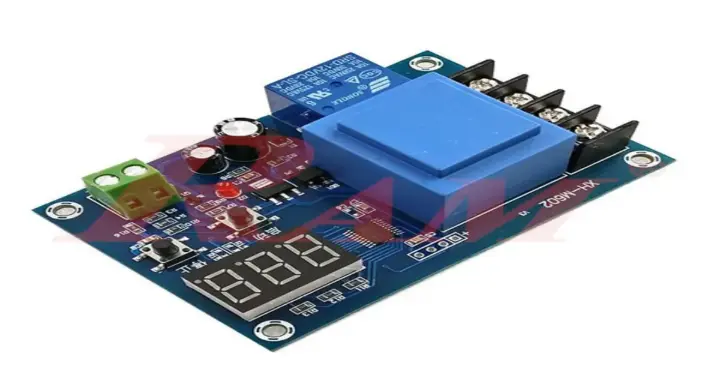
How the XH-M602 Protects Your Battery
- Monitors your battery's voltage continuously — no manual checking needed
- Automatically switches the charger off once the battery reaches your set cutoff voltage
- Automatically switches the charger on again when voltage drops below your set minimum
- Fully adjustable range: 0.0V to 120V, set with a simple button hold
- Works with any 0–120V battery type — Li-Po, Li-Fe, Li-Ion, gel, and more
- Runs directly from 220V AC — no extra power supply to buy or wire
Why This Matters for Your Battery's Lifespan
Overcharging is one of the most common — and most preventable — causes of reduced battery life. The XH-M602 removes the human error factor entirely: once it's set up, your charging routine runs itself, safely, every single time.
Set it once, protect your battery for years. Add the XH-M602 to your cart
Full Specifications
Specification | Value |
Supply voltage | 220V AC |
Working voltage range | 0–120V |
Voltage tolerance | ±0.1V |
Compatible batteries | 0–120V, any type (Li-Po, Li-Fe, Li-Ion, gel, etc.) |
Dimensions | 59 × 87 × 29 mm |
Weight | 120 g |
A Real Example — Setting It Up for a 48V Battery Pack
Say you're protecting a 48V battery bank (recommended range 54–58V). A practical setup looks like this:
- Minimum (charger turns on): 45V — the point where the pack naturally drops below 48V during normal use
- Maximum (charger turns off): 56V — safely within the recommended range, so the relay disconnects the charger automatically once reached
No manual unplugging, no guesswork — the module handles both ends of the cycle for you.
Which Model Fits Your Battery? (XH-M602 vs XH-M603 vs XH-M604)
Feature | |||
Input Voltage | 220V AC | DC 10–30V | DC 6–60V |
Best for | 3.7V–120V lithium batteries | 12–24V storage batteries | 6–60V batteries (max 80V) |
Output Type | Output switch | Direct output | Direct output |
Running straight off wall power? The XH-M602 is your model — no extra DC supply needed. Already running on a DC system? See the XH-M603 or XH-M604 instead.
Safety Tips Before You Install It
- Leave a reasonable gap between your on/off voltages (hysteresis). Setting them too close together makes the relay switch on and off rapidly, which shortens the relay's own lifespan.
- Double-check polarity before powering it on — connect input and battery terminals correctly to avoid damaging the module or your battery.
- Keep the module away from moisture, dust, and extreme temperatures.
- Don't exceed the rated voltage range for your specific model (0–120V for the XH-M602).
Frequently Asked Questions
What battery types can the XH-M602 protect?
Any 0–120V battery type — Li-Po, Li-Fe, Li-Ion, gel, and more.
Do I need any extra power supply to run this module?
No. It runs directly from 220V AC power — no separate DC supply needed, unlike the XH-M603 and XH-M604.
How precise is the voltage cutoff?
±0.1V tolerance, so your cutoff point is consistent every cycle.
Can I change the cutoff voltage later if my battery setup changes?
Yes — hold the left button to adjust the minimum, or the right button for the maximum, at any time.
Why does the manual recommend leaving a gap between my on and off voltages?
Setting them too close together causes the relay to switch rapidly back and forth near that voltage point, which wears out the relay faster than normal use would.
Every day without automatic cutoff protection is another cycle of wear on your battery. Get the XH-M602 today