Reading about a circuit and building one are two different kinds of learning — and only one of them tends to stick. STEM education (Science, Technology, Engineering, and Mathematics) has moved into schools precisely because hands-on building closes that gap.
This article looks at why STEM kits for schools matter, what a well-designed one actually includes, and how RAM Electronics has built out a dedicated STEM Kits catalog to support that kind of classroom learning.
Why Hands-On STEM Matters in the Classroom
A textbook diagram of a circuit shows a student what a switch does. Actually wiring a switch, watching an LED light up, and troubleshooting it when it doesn't — that's where the concept becomes intuitive rather than memorized. This is the core argument behind hands-on STEM learning: engineering and science concepts taught through building and testing are retained differently than concepts taught through reading alone.
For schools, this shows up in a few concrete ways:
- Problem-solving over memorization. A student debugging why their circuit isn't working is doing real engineering thinking, not recalling a fact.
- Early exposure to real disciplines. Robotics, basic electronics, and programming introduce students to fields they may not otherwise encounter until university.
- Engagement. A working project — a robot that moves, a light that responds to sound — tends to hold a student's attention longer than a diagram.
What School STEM Integration Actually Looks Like
Bringing STEM into a classroom isn't a single kit or a single lesson — it's usually a progression, matched to age and skill level:
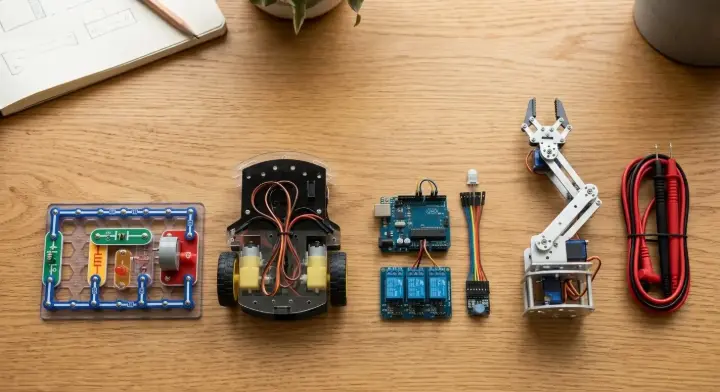
- Early/foundational level: simple, low-risk building — snap-together electric circuit kits that teach basic concepts (switches, LEDs, buzzers) without soldering or complex wiring.
- Intermediate level: guided robotics kits with a clear build sequence — assembling a robot chassis, wiring motors, and running pre-written code, often paired with a recognizable platform like the BBC micro:bit.
- Advanced level: more open-ended projects — building and coding a robotic arm, or working with AI-vision robotics kits that introduce programming concepts (like Python or ROS) alongside the hardware.
A good school STEM program moves students through this progression rather than dropping them into advanced robotics before they've built a simple circuit.
What RAM Electronics Offers for School STEM Programs
RAM Electronics maintains a dedicated DIY & Electronics for Kids | STEM Kits category, organized around exactly this kind of progression:
- Foundational circuit kits, like the Kids Electric Circuit Kit NO.500 (56 Parts) and the smaller NO.112 (16 Parts) version — maze-and-puzzle-style kits that teach basic circuit building without soldering.
- Guided robotics kits, like the Cyber:bot Complete Robot with BBC micro:bit, which pairs a ready-to-build robot with the internationally recognized micro:bit platform and available software.
- Smart-home and Arduino-based learning, like the Kit U31 Smart Home / House Kit, which teaches home-automation concepts on a real Arduino UNO board.
- Advanced robotics for older students, including the DOFBOT SE AI Vision Robotic Arm, which introduces Python and ROS programming alongside a 6-degree-of-freedom robotic arm.
- Popular entry projects, like the Bluetooth Complete Car DIY Kit — one of the catalog's best-sellers, and a common first robotics build.
Why the Right Supplier Matters for a School Program
A STEM kit that a school buys once needs to actually work, consistently, across a full classroom of students — a single faulty kit is a manageable inconvenience for a hobbyist, but a real disruption in the middle of a lesson plan for 30 students. This is where a dedicated catalog and consistent stock matter more for a school than for an individual buyer: a school needs to reorder the same kit for the next class or the next year, not hunt for a similar-but-different replacement. Working with a supplier that carries a structured range across skill levels — rather than a single kit in isolation — also makes it easier to plan a multi-year STEM curriculum instead of a one-off activity.
Frequently Asked Questions
What age group are these STEM kits suitable for?
It depends on the kit — the simpler circuit-building kits (like the electric circuit maze kits) suit younger students just starting with basic electronics, while Arduino-based and AI-vision robotics kits are better suited to older students already comfortable with more structured building and some programming.
Do these kits require soldering?
Not the foundational kits — the snap-together circuit kits and most robotics chassis kits are designed to be built without soldering, making them suitable for a classroom setting without extra safety equipment.
How does a school build a STEM curriculum around these kits, not just a single activity?
By progressing through levels rather than picking one kit in isolation — starting with basic circuit kits, moving to guided robotics with a recognizable platform like the micro:bit, and introducing programming-based kits (Arduino, AI-vision robotics) for older or more advanced students.
What's the advantage of buying STEM kits from a dedicated electronics supplier instead of a general toy retailer?
Consistent stock for reordering the same kit across classes or years, and access to the individual components and boards (Arduino, sensors, motors) if a kit ever needs a replacement part — something a general toy retailer typically can't offer.
Building the Next Generation of Engineers
STEM education works best when it's hands-on, progressive, and consistent — not a single activity, but a path from a first circuit to a working robot. RAM Electronics' STEM Kits category is built to support that path for schools and educators, with options across every skill level in one place.