A multimeter spec sheet throws a lot at you at once — display counts, True RMS, CAT ratings, auto-range — and most of it isn't explained anywhere on the product page. The right choice depends entirely on who's holding it: a student running lab exercises needs something different from an engineer diagnosing a motor drive on a factory floor.
This guide breaks down what actually matters for each, with real UNI-T models available at RAM Electronics as concrete examples.
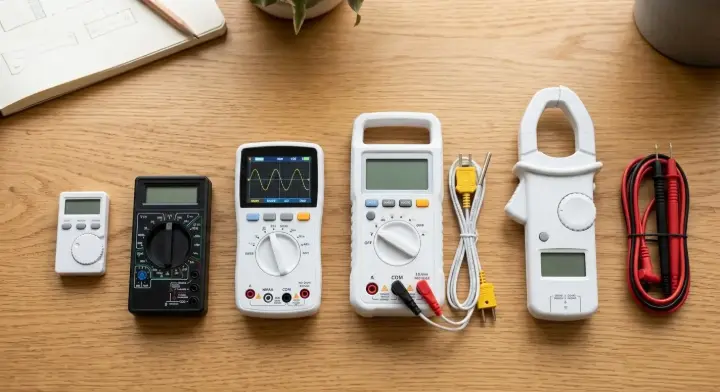
Why "Best" Depends on Who's Asking
There's no single best digital multimeter for students and engineers — there's a best multimeter for a given job. A first-year electronics student measuring a 9V battery and a field engineer chasing a fault on a three-phase motor are solving completely different problems, and a spec that matters enormously to one (True RMS accuracy on distorted waveforms) is nearly irrelevant to the other. The rest of this guide walks through the specs that actually separate a student-grade meter from a professional one, then matches real models to each use case.
Display Count Resolution: What the Number Actually Means
Every multimeter lists a "count" — 2000, 4000, 6199, 10000, 22000 — and it tells you how fine a reading the meter can display before switching ranges.
- 2000–4000 count meters round more aggressively — fine for confirming "is this wire live" or "is this resistor roughly 220Ω," which covers most introductory lab work.
- 6000+ count meters show an extra digit of resolution, useful once you're comparing components or troubleshooting a circuit where a small voltage difference matters.
- 20,000+ count meters are aimed at diagnostic and calibration work, where the last digit of precision can be the difference between finding a fault and missing it.
More resolution never hurts, but it isn't free — higher-count meters cost more, and a student doesn't need to pay for precision a basic lab exercise will never use.
True RMS: Why It Matters More Than Most Specs on the List
True RMS is the single spec most likely to separate a "good enough for class" meter from one that gives correct readings on real-world electrical work. A basic averaging multimeter calculates AC voltage and current assuming a clean sine wave — accurate on simple mains power, but wrong on distorted waveforms like those produced by variable-frequency drives, dimmer switches, or many modern electronic loads. A True RMS meter measures the actual waveform shape instead of assuming it, so the reading stays accurate whether the signal is clean or not. For a student wiring simple DC circuits, this rarely matters. For anyone diagnosing motors, drives, or industrial equipment, it's close to essential.
CAT Ratings: What the Safety Rating Actually Protects Against
CAT (category) ratings describe how much transient voltage spike a meter is built to survive without exposing the user to a dangerous arc — they're a safety rating, not a measurement-accuracy spec.
- CAT II covers general household outlets and plug-in equipment.
- CAT III covers fixed wiring, distribution panels, and industrial equipment closer to the main supply.
A student working on a breadboard with a 9V battery isn't exposed to the same fault energy as someone opening a live distribution panel, so a CAT II-rated pocket meter is genuinely appropriate for coursework — buying a CAT III meter doesn't make lab work safer, it just adds cost for protection that situation doesn't require.
Auto-Range vs. Manual Range
Auto-range meters detect the right measurement range automatically; manual-range meters require selecting it yourself. For a student still learning what range a reading should fall into, auto-range removes a common source of confusion and misreads. For an engineer who already knows the expected range at a glance, manual range can actually be faster — though most mid-range and professional meters today offer auto-range as standard anyway.
For Students: Start With a Simple, CAT II Pocket Meter
A student's first multimeter needs to cover DC/AC voltage, resistance, continuity, and basic current — reliably and without a steep learning curve.
- The UT33D+ Palm Size Digital Multimeter is built for exactly this: a CAT II 600V-rated entry-level meter with non-contact voltage (NCV) detection, a 2-meter drop-test rating, and a clear LCD — small enough for a lab bag, simple enough for a first semester.
- Stepping up slightly, the UT39A+ Digital Multimeter covers a higher CAT II 1000V / CAT III 600V rating with a 4000-count display and capacitance testing — useful if a course goes beyond the absolute basics into component testing.
For Engineers and Advanced Users: Resolution and True RMS Matter
Once the work involves diagnosing real circuits — not just confirming a reading is roughly right — the priorities shift toward precision and waveform accuracy.
- The UT61E+ True RMS Digital Multimeter offers 22,000-count resolution with True RMS measurement — the display resolution and AC accuracy needed for serious diagnostic and calibration work.
- The UT122 Smart Digital Multimeter takes a different angle on "advanced": a 6199-count True RMS meter with a rechargeable Type-C battery and a built-in temperature probe (–40°C to 1000°C) — a practical single tool for anyone who needs electrical and temperature readings on the same job without carrying two instruments.
When You Actually Need a Clamp Meter Instead
A standard multimeter measures current in-line, which means breaking the circuit open to insert the meter — not always practical, and not safe on many live circuits. A clamp meter instead measures current by clamping around a live wire, no disconnection required.
- The UT204+ Digital Clamp Meter 600A is built for exactly this — True RMS current and voltage measurement on live circuits, with a CAT III 600V rating suited to panel and motor diagnostics.
If your work involves checking live current draw on a running circuit rather than testing a de-energized one, a clamp meter belongs in the kit alongside a standard multimeter, not instead of it.
Quick Reference: Matching the Meter to the Job
Use Case | Recommended Model | Why |
First multimeter, coursework basics | UT33D+ | Simple, CAT II 600V, NCV, low cost |
Component testing beyond the basics | UT39A+ | CAT II 1000V/CAT III 600V, capacitance test |
Diagnostic/calibration-grade precision | UT61E+ | 22,000 count, True RMS |
All-in-one electrical + temperature | UT122 | True RMS, rechargeable, temperature probe |
Live current on panels/motors | UT204+ | Clamp meter, True RMS, CAT III 600V |
Frequently Asked Questions
Do I need a True RMS multimeter as a student?
Usually not for basic coursework — True RMS matters most on distorted AC waveforms (motors, drives, dimmer circuits), which most introductory lab exercises don't involve. It becomes worth paying for once your work moves toward real-world electrical or industrial diagnostics.
What does CAT rating actually protect against?
It's a safety rating describing how much transient voltage spike the meter can survive without an arc flash reaching the user — CAT II for household-level equipment, CAT III for distribution panels and fixed industrial wiring. It's not a measure of accuracy.
Should I buy a clamp meter or a regular multimeter first?
A regular multimeter first — it covers voltage, resistance, and continuity, which cover most early learning. A clamp meter becomes useful once you need to measure current on a live circuit without breaking it open, which is more of a field/professional need than a classroom one.
How much display resolution (count) do I actually need?
For confirming basic readings — is this live, is this resistor roughly the right value — 2000–4000 count is enough. Diagnostic work where small differences matter benefits from 6000+ or 20,000+ count meters instead.
Is a rechargeable multimeter worth it over one with replaceable batteries?
It's a convenience trade-off, not an accuracy one — a Type-C rechargeable meter like the UT122 means one less battery to keep on hand, at the cost of needing to charge it rather than swap a battery instantly in the field.
Ready to Pick Yours?
Whether you're starting your first electronics course or diagnosing live equipment on the job, RAM Electronics carries UNI-T's full multimeter range — an officially authorized UNI-T distributor in Egypt — with a model suited to exactly where you are, from a CAT II pocket meter to a 22,000-count diagnostic tool.