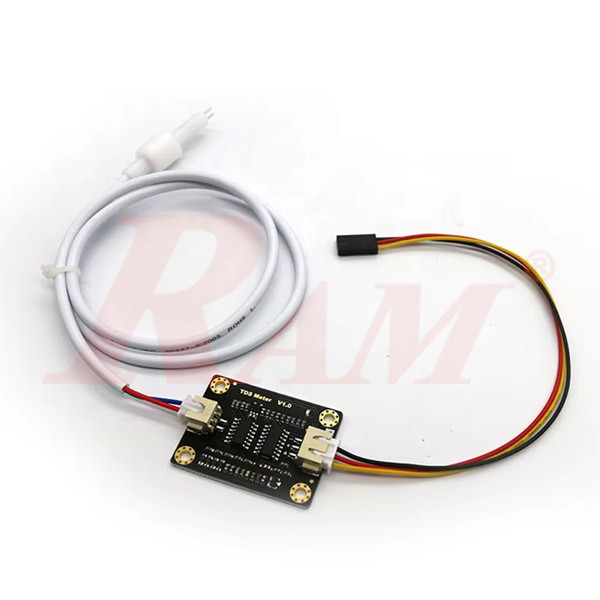
TDS Meter Analog Sensor V1.0 - Total Dissolved Solids Sensor Meter
For Water Quality Testing
مرجع داخلي:
KIT.TDS.METER
The TDS Meter Analog Sensor V1.0 is a device designed to measure the Total Dissolved Solids (TDS) in water, providing an indication of water quality. This sensor operates on the principle of conductivity, where it measures the electrical conductivity of the water, which correlates with the concentration of dissolved solids.
TDS Meter Analog Sensor V1.0 Features
- Analog Output: The sensor provides an analog voltage output that corresponds to the TDS level, making it easy to interface with microcontrollers and other electronic devices.
- Wide Measurement Range: It can measure a broad range of TDS levels, making it suitable for various applications, from aquariums to hydroponics and water quality monitoring.
- Simple Integration: The sensor is designed for easy integration into existing systems, with straightforward wiring and minimal calibration required.
- Durable Design: Built to withstand various environmental conditions, the sensor is suitable for both indoor and outdoor use.
Overall, the TDS Meter Analog Sensor V1.0 is an essential tool for anyone needing to monitor water quality, ensuring safe and healthy water for various applications.
TDS Sensor for Arduino: Analog Output and Power
As a TDS sensor for Arduino, this module gives an analog voltage output that corresponds to the TDS level, usually 0-5V or 0-3.3V. Its operating voltage is 5V DC, which is often compatible with microcontrollers like Arduino, so it is easy to interface with your electronic projects.
Water Quality Sensor for Aquariums and Hydroponics
As a water quality sensor, the TDS Meter Analog Sensor V1.0 is suitable for aquariums, hydroponics, water quality testing, and other applications where TDS measurement is essential. To monitor more water parameters in the same project, see the pH analog sensor for Arduino, the waterproof DS18B20 temperature sensor and the water turbidity sensor module.
TDS Meter Analog Sensor V1.0 Specifications
- Measurement Range:
- 0 to 1000 ppm (parts per million) or higher, depending on the model.
- Output Type:
- Analog output (usually 0-5V or 0-3.3V).
- Power Supply:
- Operating voltage: 5V DC (often compatible with microcontrollers like Arduino).
- Temperature Compensation:
- Some models may include temperature compensation to improve accuracy.
- Response Time:
- Typically within a few seconds for stable readings.
- Operating Temperature:
- Usually between 0°C to 50°C (32°F to 122°F).
- Applications:
- Suitable for aquariums, hydroponics, water quality testing, and other applications where TDS measurement is essential.
- Weight & Dimensions:
- Lightweight, typically around 50-100 grams.
- Dimensions: 40 x 31 mm
Frequently Asked Questions
What does a TDS sensor measure?
It measures the Total Dissolved Solids (TDS) in water, providing an indication of water quality. The sensor measures the electrical conductivity of the water, which correlates with the concentration of dissolved solids.
What is the measurement range of the TDS Meter Analog Sensor V1.0?
It measures from 0 to 1000 ppm (parts per million) or higher, depending on the model.
What is the output of the TDS sensor?
It has an analog output that corresponds to the TDS level, usually 0-5V or 0-3.3V.
Is the TDS sensor compatible with Arduino?
The operating voltage is 5V DC, which is often compatible with microcontrollers like Arduino.
Where can the TDS sensor be used?
It is suitable for aquariums, hydroponics, water quality testing, and other applications where TDS measurement is essential.
What are the size and weight of the sensor?
The dimensions are 40 x 31 mm, and the weight is typically around 50-100 grams.
The TDS Meter Analog Sensor V1.0 is an analog TDS sensor that is easy to interface with microcontrollers, with a 5V DC supply and straightforward wiring. If you are building a water monitoring project for your engineering graduation projects this term, RAM Electronics offers the TDS Meter Analog Sensor V1.0 in Egypt along with pH, turbidity and temperature sensors. Contact us if you need help choosing the right sensors for your project.