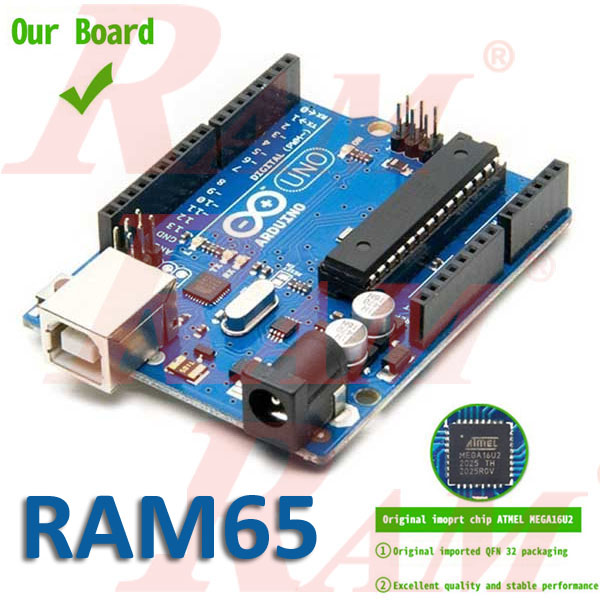
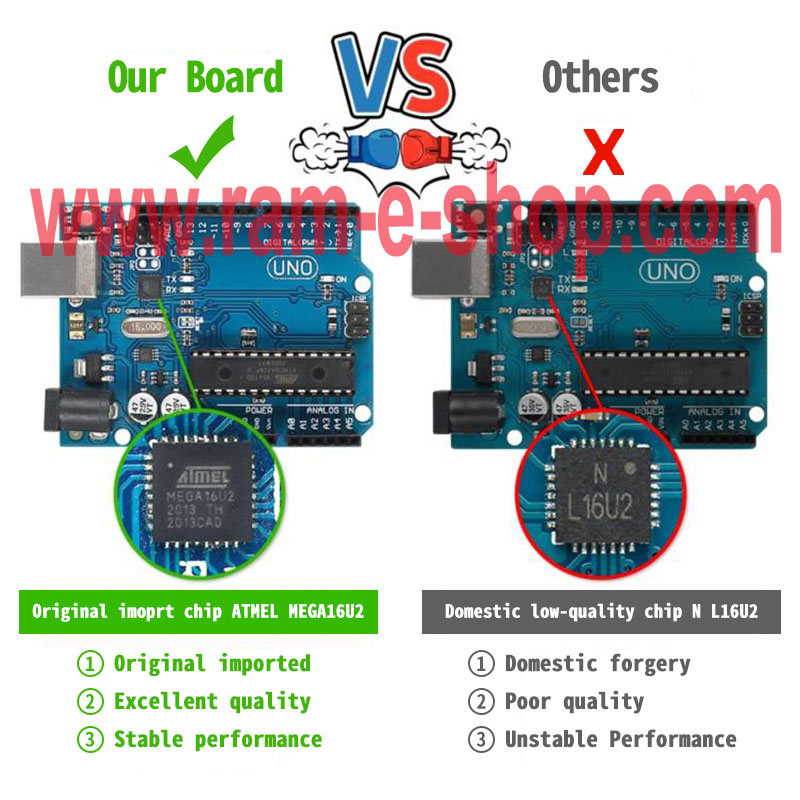
Our Arduino UNO R3 board is specially manufactured for RAM Electronics with original chips, and it is not similar to the boards available on the market.
MADE IN CHINA
The Arduino UNO Rev.3 board is a microcontroller board based on the ATmega328. It has 14 digital input/output pins (of which 6 can be used as PWM outputs), 6 analog inputs, a 16 MHz crystal oscillator, a USB connection, a power jack, an ICSP header, and a reset button. It contains everything needed to support the microcontroller; simply connect it to a computer with a USB cable or power it with a AC-to-DC adapter or battery to get started.
Summary
- Microcontroller: ATmega328
- Operating Voltage: 5V
- Input Voltage (recommended): 7-12V
- Input Voltage (limits): 6-20V
- Digital I/O Pins: 14 (of which 6 provide PWM output)
- Analog Input Pins: 6
- DC Current per I/O Pin: 40 mA
- DC Current for 3.3V Pin: 50 mA
- Flash Memory: 32 KB (ATmega328) of which 0.5 KB used by bootloader
- SRAM: 2 KB (ATmega328)
- EEPROM: 1 KB (ATmega328)
- Clock Speed: 16 MHz
Why Choose This Arduino UNO R3?
- Built with genuine MEGA16U2 and ATmega328 chips, specially manufactured for RAM Electronics — not a generic, unbranded clone board.
- The same widely-documented ATmega328 platform used across thousands of Arduino UNO R3 tutorials, libraries, and community projects.
- 14 digital I/O pins and 6 analog inputs give enough room for most beginner-to-intermediate projects without needing a bigger board.
- Fully compatible with the standard Arduino IDE toolchain and the same shields, sensors, and modules built for any Arduino UNO R3 board — including RAM's own Arduino Shield Working Area for UNO and Sensor Kit 37 in 1.
- Prefer a different chip configuration? The Arduino UNO Rev3 SMD Chip (SMD35) covers the same UNO R3 platform with an SMD-chip build.
Common Uses for This Arduino UNO R3
- Learning programming and electronics fundamentals — the most common starting board for Arduino tutorials. The Mixly Block Coding Starter Kit for Kids is a good next step for younger beginners.
- Sensor-based projects: temperature/humidity monitoring, motion detection, light sensing.
- Simple robotics and motor-control projects using PWM outputs.
- Classroom and workshop sets, where a well-documented, widely-supported board matters most — the Kit U31 Smart Home kit is a ready-made project built on this same board.
- Prototyping before scaling a design up to a custom PCB or a more specialized board.
- Browse RAM Electronics' full range of Arduino boards for more options.
Resources
- Official Arduino UNO R3 pinout diagram, datasheet, and schematics — all available on Arduino's documentation site.
Frequently Asked Questions
Is this an official Arduino board or a clone?
It's manufactured specially for RAM Electronics with genuine MEGA16U2 and ATmega328 chips — not an official Arduino-branded board, but built with original components rather than the lower-quality chips found in many generic clones.
What can I power this board with?
It accepts a recommended input of 7–12V through the power jack (6–20V at the limits), or 5V directly via the USB connection — the same power options as any standard Arduino UNO R3 board.
Do standard Arduino shields and sensors work with this board?
Yes — it uses the same pin layout and ATmega328 architecture as any Arduino UNO R3, so existing shields, sensors, and modules built for the UNO R3 are compatible.
How much program storage does this board have?
32KB of flash memory, of which about 0.5KB is used by the bootloader — enough for most beginner and intermediate sketches, though very large programs may need a board with more flash.
Looking for a reliable Arduino UNO R3 with genuine chips instead of a generic clone? Shop the Arduino UNO Rev3 (A65) at RAM Electronics this back-to-school season — built specially with original MEGA16U2 and ATmega328 components, at a better price than importing an Arduino UNO R3 clone from abroad.