Starting an electronics, mechatronics, or communications engineering program this semester? Before your first lab session, you'll need a small set of tools that almost every introductory course assumes you already have. This checklist walks through exactly what to buy, why each item matters, and which RAM Electronics products students actually use for it — no guesswork, no unnecessary extras.
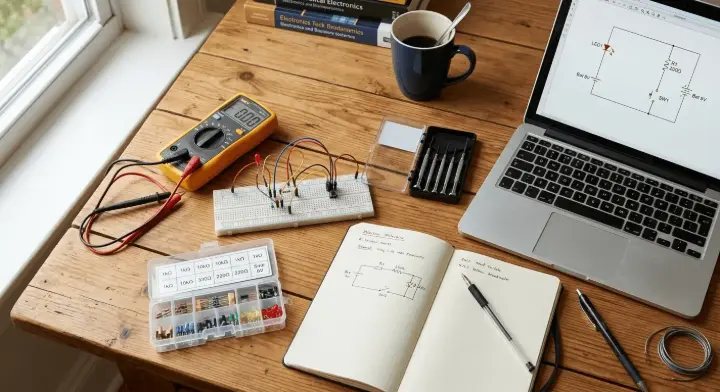
Why You Need Your Own Kit (Not Just the Lab's)
- University labs are shared and time-limited — owning your own breadboard, wires, and multimeter means you can build and test circuits at home, not just during scheduled lab hours.
- Most first-year electronics, communications, and mechatronics courses (analog circuits, digital logic, microcontrollers) use the exact same core toolset, regardless of the specific course.
- A basic kit is a one-time cost of a few hundred EGP that gets reused across multiple semesters and courses.
What's Actually in a Starter Electronics Kit?
At minimum, five things: a breadboard, jumper wires, a resistor kit, a digital multimeter, and a small hand-tool set. Here's each one in detail.
1. Breadboard
A breadboard is the reusable prototyping base you'll build every circuit on before soldering anything permanently.
- The BB-01 Breadboard (830 Tie Point) is the standard full-size breadboard used in most intro labs — 1 terminal strip (630 tie points) plus 2 distribution strips (200 tie points), 2.54mm pitch, rated 300V/3-5A, and compatible with 20–29AWG wire.
- It can be connected side-by-side with a second unit if a project outgrows one board.
2. Jumper Wires
Jumper wires connect components across the breadboard without soldering.
- The BB-J140 Jumper Wire Kit (140 pieces) covers 14 different lengths (2mm to 125mm), 25 pieces each, pre-cut and pre-stripped on both ends, in a reusable plastic case — enough variety for almost any breadboard layout in a semester's worth of labs.
3. Resistor Kit
Resistors show up in nearly every first circuit you'll build, from LED current-limiting to voltage dividers.
- The 450-Piece Resistor Kit (1/4W, 5% Tolerance) is RAM's best-selling resistor kit — 15 common values (10Ω to 1MΩ), 30 pieces of each, with a free resistor color-code chart included, so you're not left guessing a resistor's value by eye.
4. Digital Multimeter (Avometer)
You can't debug a circuit you can't measure. A multimeter checks voltage, current, resistance, and continuity — the first thing any instructor will ask you to do when a circuit doesn't work.
- The UNI-T UT33D+ Palm-Size Digital Multimeter is a compact entry-level meter rated for CAT II 600V environments, with a 2-meter drop-test rating, non-contact voltage (NCV) detection, and a continuity buzzer — built for a backpack, not a workbench.
- RAM Electronics is an officially authorized UNI-T distributor in Egypt, so UNI-T meters purchased here carry full manufacturer warranty and original parts — not grey-market imports.
5. Basic Hand Tools
A small screwdriver set and a wire stripper round out the kit for the physical side of assembly.
- The No.6066C 32-in-1 Screwdriver Set covers the small Phillips, flathead, and precision bits needed for electronics, laptop, and phone repair work — useful well beyond just one course.
Quick Reference: Student Kit at a Glance
Item | What It's For | RAM Product |
Breadboard | Build & test circuits without soldering | BB-01 Breadboard (830 Tie Point) |
Jumper Wires | Connect components on the breadboard | BB-J140 Jumper Wire Kit (140 pcs) |
Resistor Kit | Current limiting, voltage dividers, and more | 450-Piece Resistor Kit (1/4W, 5%) |
Digital Multimeter | Measure voltage, current, resistance, continuity | UNI-T UT33D+ Palm-Size Multimeter |
Hand Tools | Assembly, disassembly, minor repairs | No.6066C 32-in-1 Screwdriver Set |
Ready for Your First Microcontroller Course?
If your syllabus also covers Arduino or embedded systems, it's worth adding one more item: the TR-02 Arduino Basic Starter Kit, a sensors-and-training kit built around the Arduino UNO R3 that adds guided projects on top of the same breadboard-and-jumper-wire basics covered above.
Frequently Asked Questions
Do I really need my own multimeter if the lab has some?
- Lab multimeters are shared and often in use during peak hours.
- Owning one means you can debug your circuit at home before the next lab session instead of waiting.
- An entry-level meter like the UT33D+ is inexpensive enough that most students buy their own by the second semester anyway.
What resistor values should a beginner kit include?
- A well-rounded kit spans a wide range — from 10Ω up to 1MΩ — since different circuits (LED limiting, pull-up/pull-down, voltage dividers) need very different values.
- A kit with a printed color-code chart (like RAM's 450-piece kit) saves time until you memorize the resistor color code.
Is a 400-tie-point breadboard enough, or should I get a bigger one?
- For most first-semester coursework (single ICs, a handful of LEDs and resistors, basic sensor circuits), an 830-tie-point board like the BB-01 is enough.
- If your course moves into larger microcontroller projects, boards can be connected side-by-side later — no need to buy a bigger one upfront.
Why does distributor status matter for a multimeter?
- An officially authorized distributor (like RAM for UNI-T) sells units that come with valid manufacturer warranty and genuine components.
- Grey-market or reseller units of measuring instruments often lack warranty support if a sensor or display fails.
Ready to Build Your Kit?
Skip the back-and-forth between five different sellers. Get your breadboard, jumper wires, resistor kit, multimeter, and basic tools from RAM Electronics — an officially authorized UNI-T distributor in Egypt — and have everything ready before your first lab session.