



Product Description
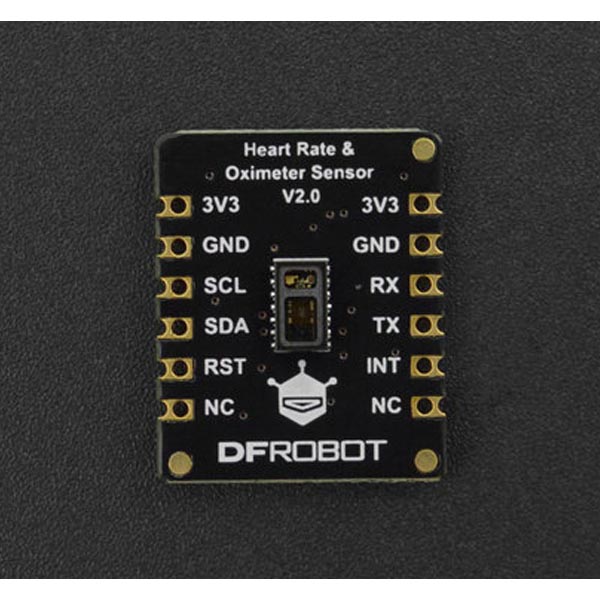
The DFRobot Fermion MAX30102 PPG Heart Rate and Oximeter Sensor V2.0 (SEN0344) is a compact biometric sensor module designed to measure heart rate and blood oxygen saturation (SpO2) using Photoplethysmography (PPG) technology.
Based on the Maxim MAX30102 optical sensor, this V2.0 module integrates an onboard microcontroller with built-in heart rate and blood oxygen measurement algorithms. Unlike basic MAX30102 breakout boards that require the main controller to process raw optical signals, this version calculates the measurement values internally and outputs the processed heart rate and SpO2 data directly.
The module supports both I2C and UART communication interfaces, making it easy to integrate with Arduino, ESP32, Raspberry Pi, and other embedded development platforms. It also supports PC-based data visualization, allowing developers to monitor measurement results during testing and development.
With its compact breakout design and low power consumption, the SEN0344 is suitable for wearable electronics, fitness monitoring projects, portable health-related prototypes, and educational applications involving physiological measurements.
Important: This module is intended for development, experimentation, and monitoring projects. It is not a professional medical device and must not be used for medical diagnosis or treatment.
Specifications
| Parameter | Specification |
|---|---|
| Brand | DFRobot |
| Model | SEN0344 |
| Product Version | V2.0 |
| Sensor IC | MAX30102 |
| Measurement Technology | Photoplethysmography (PPG) |
| Measurement Parameters | Heart Rate and Blood Oxygen Saturation (SpO2) |
| Signal Processing | Onboard MCU with integrated measurement algorithms |
| Power Supply | 3.3V DC |
| Working Current | Less than 15mA (DFRobot product specification) |
| Communication Interfaces | I2C / UART |
| I2C Address | 0x57 |
| UART Baud Rate | 9600 bps |
| Operating Temperature | -40°C to +85°C |
| Dimensions | 18 × 22 mm |
| PC Monitoring | Supported |
| Main Controller Compatibility | Arduino, ESP32, Raspberry Pi |
Technical Information
1. PPG Measurement Technology
The MAX30102 uses Photoplethysmography (PPG), an optical sensing technique that detects changes in blood volume beneath the skin. It uses red and infrared light to collect optical signals, which are processed to calculate heart rate and blood oxygen saturation.
2. Integrated Measurement Algorithms
One of the main advantages of the V2.0 version is its onboard microcontroller with integrated heart rate and oximetry algorithms.
The module processes the optical signals internally and outputs calculated measurement values directly. This reduces the processing workload on the connected microcontroller and simplifies software development compared with basic MAX30102 modules that provide raw sensor data.
3. Dual Communication Interfaces
The SEN0344 supports two communication methods:
- I2C: Digital communication using the SDA and SCL lines. The default I2C address is 0x57.
- UART: Serial communication with a default baud rate of 9600 bps.
These interfaces provide flexibility when connecting the module to different development platforms.
4. PC-Based Data Monitoring
The module supports a dedicated PC application that allows users to connect through a USB-to-serial adapter and monitor heart rate and SpO2 readings directly on a computer. This is useful for development, debugging, and experimental data observation.
5. Measurement Stability and Sensor Placement
For more stable measurements, the sensor should be securely positioned against the fingertip using a suitable strap. Avoid pressing directly on the sensor, as changes in finger pressure can affect the optical readings.
Features
- Based on the Maxim MAX30102 optical sensor.
- Uses Photoplethysmography (PPG) technology.
- Measures heart rate and blood oxygen saturation (SpO2).
- V2.0 includes an onboard microcontroller with integrated measurement algorithms.
- Outputs calculated heart rate and SpO2 values directly.
- Supports I2C and UART communication.
- Default I2C address of 0x57.
- UART communication at 9600 bps.
- Low working current of less than 15mA according to DFRobot's specification.
- Supports PC-based data monitoring.
- Compatible with Arduino, ESP32, Raspberry Pi, and other embedded platforms.
- Compact 18 × 22 mm breakout board.
Applications
- Wearable Electronics: Development of wearable devices for heart rate and SpO2 monitoring.
- Fitness Monitoring: Heart rate and blood oxygen measurement in fitness-related projects.
- Portable Monitoring Devices: Development of compact physiological monitoring prototypes.
- Educational Projects: Learning about PPG technology, optical sensors, and biometric measurements.
- Arduino and ESP32 Projects: Integration of heart rate and SpO2 measurements into embedded systems.
- IoT Monitoring Systems: Collecting physiological measurement data for experimental monitoring applications.
- Research and Development: Prototyping and evaluating optical biometric sensing systems.
Frequently Asked Questions (FAQ)
Q1: What parameters can the MAX30102 V2.0 sensor measure?
It measures heart rate and blood oxygen saturation (SpO2) using Photoplethysmography (PPG) technology.
Q2: What is the difference between MAX30102 V1.0 and V2.0?
The V2.0 version includes an onboard microcontroller with integrated heart rate and oximetry algorithms. It processes the optical signals internally and outputs calculated heart rate and SpO2 values directly. The older V1.0 version requires the main controller to process the sensor data.
Q3: Does this module output raw sensor data or calculated measurements?
The V2.0 module outputs processed heart rate and SpO2 measurement values through I2C or UART, reducing the need for complex signal-processing algorithms on the main controller.
Q4: Which communication interfaces does the module support?
It supports both I2C and UART communication. The default I2C address is 0x57, and the UART baud rate is 9600 bps.
Q5: Is the sensor compatible with Arduino and ESP32?
Yes. It can be integrated with Arduino, ESP32, Raspberry Pi, and other compatible development platforms.
Q6: Can I monitor the sensor readings on a computer?
Yes. DFRobot provides a PC monitoring application that allows users to view heart rate and SpO2 readings through a USB-to-serial connection.
Q7: How should the sensor be positioned for measurement?
The sensor should be securely fixed against the fingertip using a suitable strap. Avoid applying excessive pressure directly to the sensor, as changes in pressure can affect measurement results.
Q8: Can this sensor be used in medical devices or for clinical diagnosis?
No. This is a development and prototyping module, not a certified professional medical instrument. It should not be used for medical diagnosis, treatment, or clinical decision-making.