If you're searching for an ESP32 cam board that goes beyond the classic setup, the Ai-Thinker AiPi-CAM-D200 is worth a close look. It pairs a 2-megapixel camera with a newer RISC-V processor, WiFi 6, Bluetooth 5.3, and hardware-level security — features that weren't available on earlier ESP32-CAM boards.
This guide walks through what each of those features actually means for your project, how this board compares to a classic ESP32-CAM on price and specs, and how to get started.
Ready to see full details? View the Ai-Thinker AiPi-CAM-D200 product page
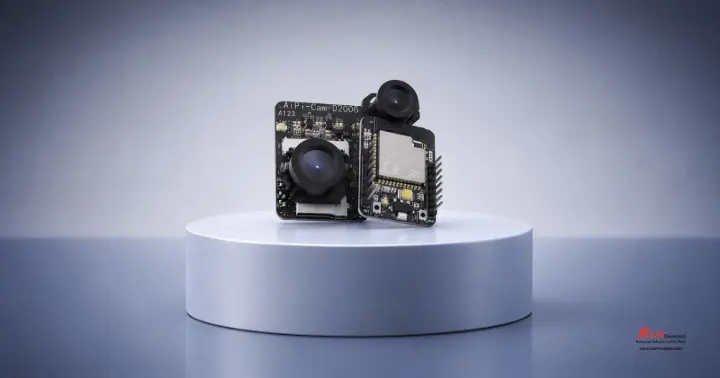
What Is the Ai-Thinker AiPi-CAM-D200?
The AiPi-CAM-D200 is a compact camera development board from Ai-Thinker, built around the Ai-M61-32S processor module and a GC2145 2-megapixel camera sensor.
It's designed for IoT, embedded vision, smart home, and wireless camera applications, and is pin-compatible with Ai-Thinker's earlier Ai-WB1-32S-CAM boards — so existing mounts and project layouts built for older boards still fit.
ESP32 Camera Board with Built-in WiFi 6 — Why It Matters
This board supports WiFi 802.11 b/g/n/ax — the "ax" standard is what's commonly known as WiFi 6. In practical terms, that means better performance on congested networks (like a home with many connected devices) and generally more efficient power use during data transmission compared to older WiFi 4 (802.11 b/g/n) boards.
For a wifi camera module that needs to stream video reliably, that efficiency matters more than the headline speed number.
RISC-V Processor Up to 320 MHz — What This Means for Your Project
The board runs on Ai-Thinker's Ai-M61-32S module, a 32-bit RISC-V processor clocked up to 320 MHz, backed by 532 KB of SRAM and 4 MB of pSRAM.
In practice, that extra headroom compared to older camera boards gives you more room to run image processing tasks — like basic motion detection or lightweight edge-AI inference — directly on the board, instead of relying entirely on a separate server or cloud service.
Camera Board with Micro-SD Storage for Local Recording
An onboard micro-SD (TF card) slot lets you record images or video directly to local storage, independent of your WiFi connection. That's a practical safeguard for projects like security cameras — if the network drops, you still have a local recording rather than losing footage entirely.
Edge-AI Ready: Security & Encryption Features Explained
For a camera board specifically, security isn't just about the video feed — it's about protecting the device itself from being hijacked on your network.
The AiPi-CAM-D200 includes hardware-accelerated AES and SHA encryption, RSA/ECC cryptography support, a true random number generator, Secure Boot and Secure Debug, TrustZone isolation, and on-the-fly AES decryption for external flash.
Together, these make the board a more defensible choice for internet-connected camera projects than boards without dedicated security hardware.
Compact Camera Board Size — Fits Any Project Enclosure
At approximately 40.1 × 27 × 6.3 mm with a standard 2.54 mm pin pitch, the board is breadboard-friendly and small enough to fit inside compact enclosures — useful for discreet security cameras or space-constrained IoT builds.
It includes a power LED and a user-programmable indicator LED for basic status feedback without needing a separate display.
AiPi-CAM-D200 vs. Classic ESP32-CAM: Price & Spec Comparison
If you've used a classic ESP32 cam board before, here's how the AiPi-CAM-D200 compares on the specs that matter most:
|
Feature |
AiPi-CAM-D200 |
Classic ESP32-CAM (OV2640) |
|
Price |
850 EGP |
~300 EGP (RAM listing price, currently out of stock) |
|
Processor |
RISC-V, up to 320 MHz |
Dual-core Xtensa LX6, up to 240 MHz |
|
Camera Sensor |
GC2145, 2MP |
OV2640, 2MP |
|
WiFi |
WiFi 6 (802.11 b/g/n/ax) |
WiFi 4 (802.11 b/g/n) |
|
Bluetooth |
BLE 5.3 |
Classic BT / older BLE stack |
|
Hardware Security |
AES/SHA acceleration, Secure Boot, TrustZone |
None |
|
Local Storage |
Micro-SD slot |
Micro-SD slot |
The price difference reflects the added processor performance, WiFi 6 support, and hardware security — for a basic camera-only project with no security requirements, a classic ESP32-CAM board may still be sufficient.
For anything internet-connected, handling sensitive footage, or doing on-device processing, the extra cost buys real functional differences, not just a newer label.
See the full specs and current availability on the Ai-Thinker AiPi-CAM-D200 product page
How to Get Started with the AiPi-CAM-D200
1. Connect the board to your computer via USB — the onboard regulator handles the 5V-to-3.3V conversion, so no external power circuit is needed for initial testing.
2. Set up your development environment (Arduino IDE or ESP-IDF) with support for the Ai-M61-32S module and select the GC2145 camera sensor in your project configuration.
3. Upload a basic camera capture or streaming sketch to confirm the board and camera are communicating correctly.
4. Insert a micro-SD card if your project needs local storage, and configure your code to write captured images or video to it.
5. Connect the board to your WiFi network and test streaming or remote access before adding project-specific logic (motion detection, edge-AI models, etc.).
Who Should Buy This Board?
Choose the AiPi-CAM-D200 if: you're building an internet-connected camera project where security matters (a home security camera, a monitored access point), you want local SD storage as a backup to WiFi streaming, or your project could benefit from on-device processing thanks to the faster RISC-V processor.
Consider a classic ESP32-CAM instead if: your project is a simple, offline, or non-critical camera build where the extra processing power and security features wouldn't be used.
Already working in the Raspberry Pi ecosystem instead of ESP32? If your project is built around a Raspberry Pi rather than an ESP32 board, the Raspberry Pi AI Camera offers a comparable on-device AI processing capability built for that platform instead.
Frequently Asked Questions
Is the AiPi-CAM-D200 compatible with classic ESP32-CAM projects and code?
Yes, the board is pin-compatible with previous Ai-Thinker Ai-WB1-32S-CAM boards, and is designed to work with the same ESP32-CAM ecosystem, so most existing projects and tutorials transfer over with minimal changes.
What's the difference between the AiPi-CAM-D200 and a classic ESP32-CAM board?
The AiPi-CAM-D200 uses a newer Ai-M61-32S RISC-V processor running up to 320 MHz, supports WiFi 6 and Bluetooth 5.3, and includes hardware-level security features like AES/SHA acceleration and Secure Boot — capabilities not found on the original ESP32-CAM.
Does the AiPi-CAM-D200 support local video storage?
Yes, it has an onboard micro-SD (TF card) slot for local image and video storage, in addition to its wireless streaming capabilities.
What camera resolution does this board support?
It uses the GC2145 2-megapixel sensor, capturing up to 1600×1200 resolution, with frame rates up to approximately 52 fps at lower resolutions like 160×120.
Is this board suitable for edge-AI applications like facial recognition?
Yes, the board's processing power and built-in security features (including hardware AES/SHA acceleration) make it suitable for edge-AI vision tasks such as facial recognition and QR scanning.
Ready to start your build? Shop the Ai-Thinker AiPi-CAM-D200 now or explore the full range in our Audio, Sound & Camera Modules collection for more camera and vision options.